
Good-Feel's latest Yoshi outing trades challenge for discovery and ends up delivering Nintendo's most inventive platformer in years. The question is whether the industry knows how to celebrate a game like this.
Editor's Take
Yoshi and the Mysterious Book is a breathlessly imaginative platformer that replaces traditional challenge with systemic discovery, delivering a hand-crafted toybox that rewards curiosity over reflexes. It is also the most misunderstood game of 2026.
Pros
- Genuine sense of discovery in every level
- Stop-motion art direction is stunning
- Systemic sandbox design rewards experimentation
- No fail states respect young players
- Creature interactions are consistently delightful
Cons
- Zero mechanical challenge for veterans
- Short runtime at roughly 10 hours
- Sweetness can overwhelm in long sessions
- No multiplayer or co-op mode
Game at a Glance
| Detail | Info |
|---|---|
| Platform | Nintendo Switch 2 |
| Developer | Good-Feel |
| Publisher | Nintendo |
| Release Date | May 21, 2026 |
| Genre | Side-Scrolling Platformer |
| Playtime | 10–15 hours (full discovery) |
| Price | $59.99 USD (approximately $79.99 CAD) |
| Engine | Unreal Engine 5 |
| Multiplayer | No |
| Verdict | A uniquely inventive platformer that prioritizes creative discovery over mechanical challenge, best enjoyed as a digital toybox rather than a traditional game. |
Introduction: What Yoshi and the Mysterious Book Gets Right
The criticisms write themselves. “It is a kiddy game.” “It is too easy.” “There is no point.” You can already see the review scores clustering around the low end of the scale, the forum threads dismissing Good-Feel's latest as another lightweight Yoshi outing that coasts on charm while demanding nothing from the player.
All of those criticisms are factually correct. Yoshi and the Mysterious Book is a game designed so a five-year-old can complete it. There are no fail states. No lives. No game over screen. Enemies cannot damage you. The game never demands mastery of anything. What those criticisms miss is that these are features, not bugs. Nintendo and Good-Feel built a platformer around discovery and experimentation rather than execution and punishment, and the result is the most creatively rich sidescroller since Super Mario Bros. Wonder.
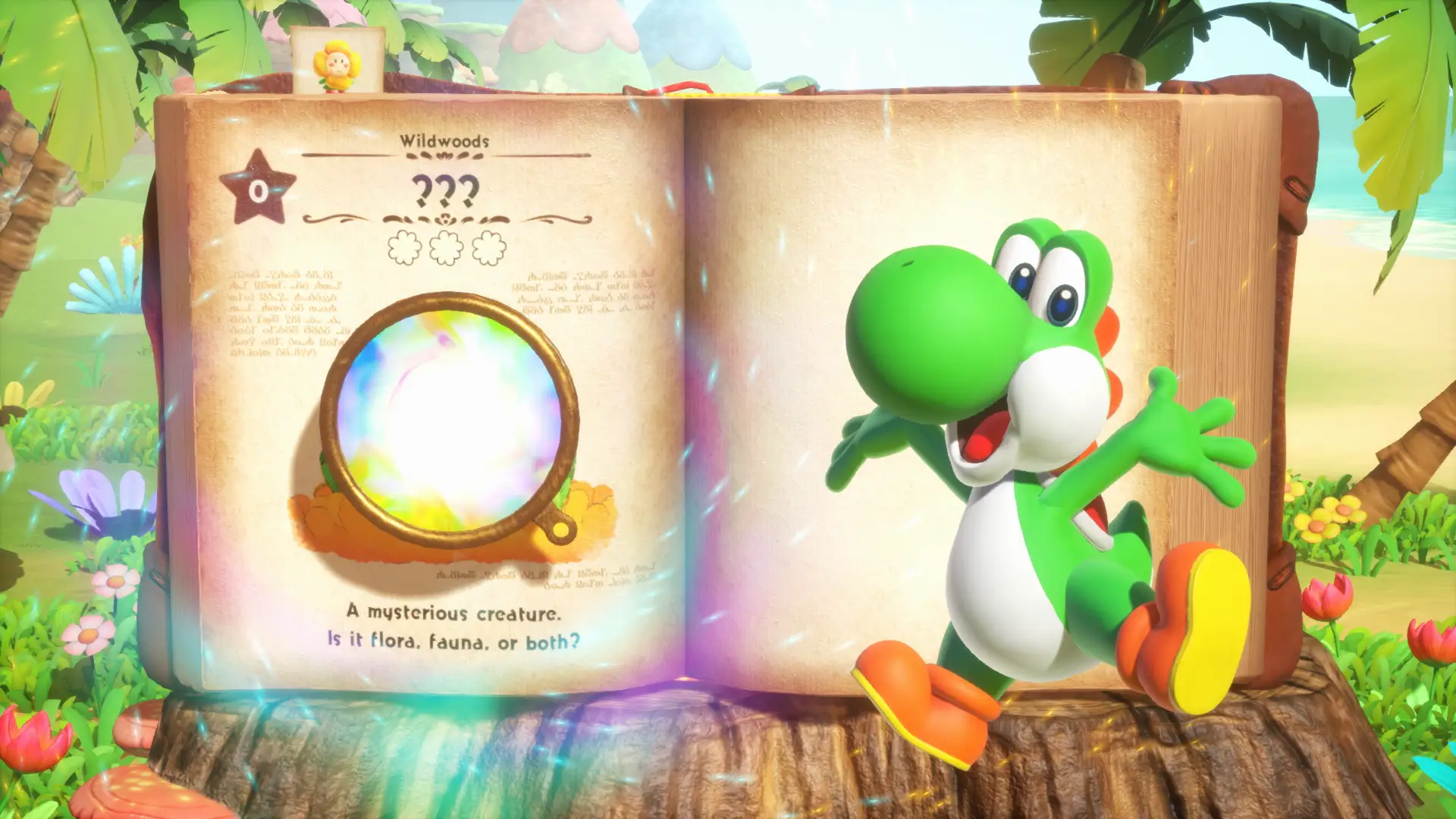
The premise is straightforward. An enchanted encyclopedia named Mr. E falls onto Yoshi's island, its pages filled with fantastical creatures that need studying. Yoshi enters the book, explores each chapter's habitat, and interacts with its inhabitants using the only tools at his disposal: a flutter jump, a sticky tongue, and an endless supply of eggs. Bowser Jr. and Kamek are also poking around inside the book, searching for a legendary creature called the Bewilder Bird, but they function more as comic relief than genuine antagonists. The real star is the bestiary.

Story and World: A Living Encyclopedia
The narrative framing is light by design. Mr. E tasks Yoshi with cataloguing its creatures. Each level represents a chapter, and each chapter introduces a new species with unique behaviors, habitats, and interactive properties. Bowser Jr. provides occasional friction, but the game treats him as a nuisance who occasionally needs an egg to the face rather than a genuine threat. Kamek, lost inside the book for years, mistakes Bowser Jr. for a young Bowser, a running gag that lands better than it should.
The real storytelling happens through the creatures themselves. A slug that curls into a boomerang when thrown. A big-mouthed plant that functions as a bug net. A googly-eyed surfboard creature that carries Yoshi across waves and through shipwrecks. A frog-like critter that blows rideable bubbles. Each species feels like a character rather than a mechanic, and the game gives you space to simply observe them before asking you to use them.
The Bewilder Bird, revealed late in the adventure, ties the whole concept together. It can transform into any creature in the book, which means every interaction you have learned becomes a tool in the final sequence. It is a payoff that rewards attention rather than reflexes, and it lands precisely because the game spent hours teaching you to care about its ecosystem.
Gameplay: Discovery Over Difficulty
Yoshi and the Mysterious Book is not a puzzle game, even though it behaves like one. Most “solutions” announce themselves the moment you see the relevant creatures. You spot a chili. You remember the frog critter from three levels ago that reacts to spicy food. You bring them together. The frog breathes fire, a wall of thorns burns away, and a new path opens. You did not solve a puzzle. You followed a thread of curiosity to its natural conclusion.
This is the core loop, and it works because Good-Feel never lets a single idea overstay its welcome. As soon as you have mastered one creature's interactions, the game introduces another, then another, layering them into levels that function as systemic sandboxes rather than linear obstacle courses. One moment you are casting a fishing line with an anthropomorphic angler creature. The next you are riding a glider through cloud layers. Then you are pinballing through the jaws of a bus-sized beast. The pace of invention is relentless.
The game tracks properties like weight, temperature, and water quality across its levels. Creatures interact with each other in unexpected ways. A static creature you have been bouncing off for three levels might stand up and walk away if you feed it the right item, revealing a hidden area underneath. Another might absorb water and grow large enough to smash through hard rock. The scribbled notes that appear on the level scenery as you learn each creature's traits serve as a permanent knowledge base, and carrying that knowledge into late-game stages to hunt down every hidden collectible is deeply satisfying.
The controls are frictionless. Yoshi's flutter jump, tongue grab, and egg throw respond instantly. The stop-motion animation, running at a deliberately lower frame rate for character actions, gives every movement a tactile, hand-crafted weight. If you can conceive of an interaction within the game's systems, you can execute it.
The absence of fail states is the design choice that will divide audiences. You cannot die. Enemies knock you back but deal no damage. Bottomless pits bounce you back to solid ground. For players raised on precision platformers like Celeste or Super Meat Boy, this feels like the game refusing to engage. For a five-year-old experiencing their first platformer, or an adult unwinding after a long day, it is liberation. The game trusts you to find your own fun without threatening you into it.


Presentation: Stop-Motion Magic
Good-Feel established the Yoshi series' visual identity with Woolly World's yarn aesthetic and Crafted World's cardboard dioramas. Mysterious Book pushes further. The hand-drawn art style, complete with visible sketch lines in the backgrounds and a stop-motion quality to character animation, makes every frame look like a page from a children's book that someone breathed life into. Unreal Engine 5 handles lighting and depth of field in ways that make the 2D plane feel three-dimensional without breaking the illustrated illusion.
The creature designs are the highlight. Good-Feel's artists clearly had freedom to go strange. The bestiary ranges from adorable to genuinely odd, and the variety holds across the full runtime. No two creatures feel like reskins of each other. Each has a distinct silhouette, movement pattern, and personality conveyed entirely through animation.
Kumi Tanioka's soundtrack matches the visual tone. The compositions are light, melodic, and never intrusive. They shift subtly between chapters to reflect each habitat's mood without demanding attention. It is background music in the best sense: present enough to shape the atmosphere, restrained enough to let the sound design carry the interactive moments.
The naming mechanic deserves a mention. After studying a creature, you can give it a name. The game does not judge your choices. This is the kind of feature that will generate viral social media clips as players share screenshots of Yoshi proudly presenting a creature they named something absurd. It is a small touch that reinforces the game's core message: this world is yours to play with.
How Yoshi and the Mysterious Book Compares
| Feature | Yoshi and the Mysterious Book | Super Mario Bros. Wonder | Kirby and the Forgotten Land | Yoshi's Crafted World |
|---|---|---|---|---|
| Core Loop | Creature discovery and interaction | Traditional platforming with Wonder effects | Copy-ability combat and exploration | Collectible hunting with flipped perspectives |
| Difficulty | No fail states, zero combat damage | Moderate, with assist options | Easy to moderate, boss fights present | Easy, with fall damage and enemy hazards |
| Art Style | Hand-drawn stop-motion, sketchbook aesthetic | Expressive 2D animation, vibrant colors | 3D cel-shaded, post-apocalyptic playgrounds | Cardboard and craft diorama |
| Level Design | Systemic sandboxes, multiple solutions | Linear with branching Wonder Seed paths | 3D zones with hidden objectives | 2.5D linear with backwards perspective runs |
| Playtime | 10–15 hours | 10–15 hours | 15–20 hours | 10–15 hours |
| Price | $59.99 USD (~$79.99 CAD) | $59.99 USD | $59.99 USD | $59.99 USD (launch) |
| Innovation | Creature ecosystem with systemic interactions | Wonder Flower reality-warping | Full 3D Kirby with Mouthful Mode | Flipped perspective gimmick |
| Best For | Creative discovery and young players | Pure platforming joy and surprise | Accessible 3D adventure | Craft-themed collectible hunting |
Yoshi and the Mysterious Book carves its own lane. Super Mario Bros. Wonder is the better pure platformer. Kirby and the Forgotten Land offers more structure and combat variety. But neither attempts what Mysterious Book does: building an entire game around systemic creature interactions where the reward is the discovery itself rather than the completion.
FAQ: Your Questions Answered
Is Yoshi and the Mysterious Book worth buying at full price?
Yes, if you value creative discovery over mechanical challenge. At $59.99 USD (approximately $79.99 CAD through major Canadian retailers like Best Buy Canada and Amazon.ca), the 10 to 15 hours deliver a consistently inventive experience. Players who need difficulty to stay engaged should consider Super Mario Bros. Wonder instead.
How long does it take to beat Yoshi and the Mysterious Book?
The main adventure takes roughly 8 to 10 hours. Full completion, including hunting down every hidden creature interaction and collectible, extends to roughly 15 hours.
Does Yoshi and the Mysterious Book have multiplayer or co-op?
No. The game is a single-player experience. Previous Yoshi titles like Crafted World offered co-op, but Mysterious Book focuses entirely on solo discovery.
Is Yoshi and the Mysterious Book too easy for adults?
The game has no fail states, no combat damage, and no game over screen. If you need mechanical challenge to enjoy a platformer, this will not satisfy you. If you can appreciate a game that replaces difficulty with discovery, it is one of the most inventive platformers in years.
How does Yoshi and the Mysterious Book run on Nintendo Switch 2?
The game targets 60 fps with the stop-motion animation running at a deliberately lower frame rate for character actions. No performance issues were observed during the review period.
When will Yoshi and the Mysterious Book be available in Canada?
Yoshi and the Mysterious Book launched worldwide on May 21, 2026, including Canada. It is available at major Canadian retailers including Best Buy Canada, Amazon.ca, GameStop Canada, and Walmart Canada for approximately $79.99 CAD.
Verdict: Is Yoshi and the Mysterious Book Worth Your Time?
Yoshi and the Mysterious Book is the most inventive Nintendo platformer since Super Mario Bros. Wonder, and it achieves that by rejecting the core assumption that platformers must test your thumbs. Good-Feel built a systemic sandbox where every creature interaction feels like a small discovery, where levels reward curiosity rather than execution, and where the absence of fail states is not a concession to children but an invitation to play without pressure.
The game will divide audiences. Critics who measure platformers by their difficulty curves will find nothing to chew on. Players who can meet the game on its own terms will find a hand-crafted toybox filled with moments of genuine delight. In an industry that often equates value with friction, Yoshi and the Mysterious Book makes a quiet, confident case that joy is enough.