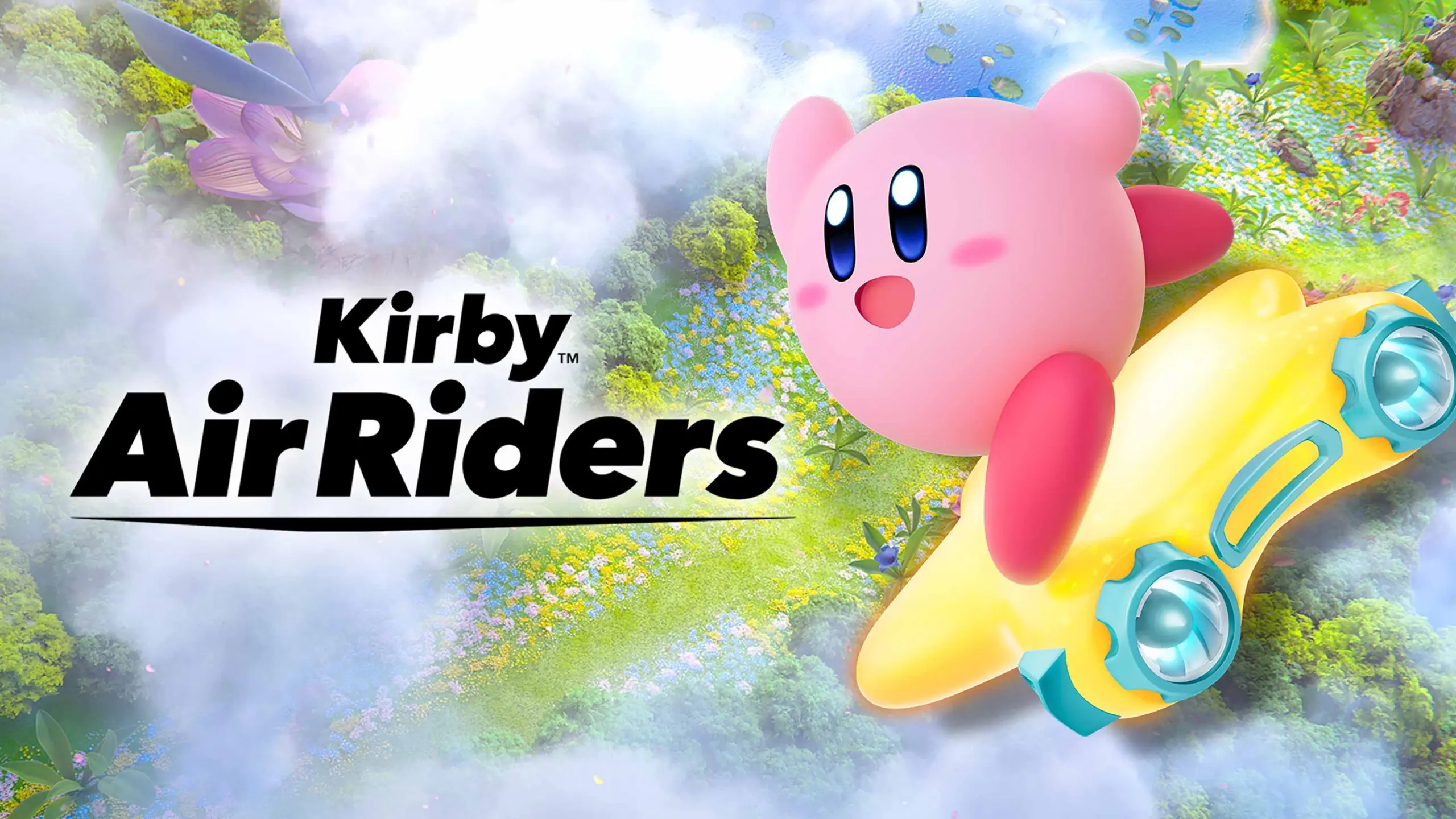

Kirby Air Riders is not trying to reinvent arcade racing. Masahiro Sakurai's follow-up to the 2003 GameCube cult title arrives on Nintendo Switch 2 with the same core philosophy its predecessor established: minimal inputs can carry surprising depth, speed is its own reward, and chaos is the feature. Two decades later, the question was never whether a sequel could exist. It was whether one could still feel necessary. For the most part, it does.
Editor's Take
Kirby Air Riders delivers a confident, speed-forward arcade racer that rewards patience and punishes complacency, though its unconventional controls and niche scope will divide players expecting a traditional kart experience.
Pros
- City Trail mode is chaotic, replayable, and compelling at its best
- Machine variety meaningfully changes how each race plays out
- Copy abilities as limited-use tools add real tactical weight
- Road Trip delivers digestible, quick-hit single-player content
- Top Rides offers a genuinely distinct racing perspective
Cons
- Tilt-based controls will put off players expecting standard kart input
- City Trail builds can feel punished by randomized Stadium match types
- Solo play runs short without the full multiplayer experience
- Character roster could use deeper mechanical differentiation
Game at a Glance
| Detail | Info |
|---|---|
| Platform | Nintendo Switch 2 |
| Developer | HAL Laboratory |
| Publisher | Nintendo |
| Genre | Arcade Racing |
| Players | 1 to 8 (local and online) |
| Price | $59.99 USD (approximately $79.99 CAD) |
| Modes | Road Trip, City Trail, Top Rides |
| Multiplayer | Yes, up to 8 players |
| Verdict | A focused, chaotic arcade racer built on a beloved cult blueprint, best enjoyed with others. |
What Kirby Air Riders Gets Right
Kirby Air Riders looks and plays like a project built from genuine affection for its source material. The menus are clean and purposeful. The art direction leans into the franchise's signature pastel brightness, and each of the 12 characters arrives with enough visual personality to make roster selection feel considered rather than arbitrary.
The full roster covers Kirby, King Dedede, Meta Knight, Bandana Waddle Dee, Chef Kawasaki, Magolor, Gooey, Waddle Doo, Knuckle Joe, Susie, Cappy, and Starman. Colour variants add minor mechanical wrinkles on top of that: Blue Kirby carries the Snow Bowl ability, while Yellow Kirby brings Crash. These are small touches, but they reward players who want to optimize without making variety feel mandatory.
The game's charm is consistent and earned. Nothing about the presentation feels padded or stretched. Sakurai's fingerprints are on the reward structure too, with in-game unlocks, license card stickers, and machine parts feeding a collection loop that keeps short sessions feeling productive.
Gameplay: Machines, Controls, and the Racing Loop
The control scheme is the first thing that will stop new players cold, and it is also what makes Kirby Air Riders distinct. Steering uses left-right tilts rather than a dedicated turn input. One button handles Boost Charge. Holding B brakes. Tilting and holding B together initiates a drift. Nose-up sends you airborne and nose-down brings descent. There is no traditional throttle. For anyone arriving from Mario Kart World, the first few minutes will feel disorienting.
That disorientation is temporary. The schema is more intentional than it first appears, and the game offers a structured Lessons system split across basic, advanced, and ability-specific tracks to ease the transition. The machine tutorial in particular is worth completing before jumping into competitive modes. Understanding how the Bulk Star uses charge as fuel, or how the Swerve Star only accelerates out of a full stop, is not optional knowledge. It is the foundation everything else builds on.
Copy abilities return but work differently than in standard Kirby titles. Abilities are now shared across the full roster rather than exclusive to Kirby. Plasma no longer requires charging and activates automatically, which reduces micromanagement overhead and keeps focus where it belongs: on the race itself. Abilities are limited-use, making timing critical. Spamming is not a viable strategy.
The Special Gauge is the key new system. Fill the meter and you can trigger a character-specific move. Kirby slashes with a large blade. King Dedede drives forward with a jet hammer. Meta Knight propels ahead with Night Wing. Bandana Waddle Dee spins a Spear Cyclone that doubles as a shield. Chef Kawasaki hurls superspicy food at opponents. These are deliberate tools, not passive buffs. Knowing when to spend the gauge versus holding it is a decision that consistently matters mid-race.
Machine selection rounds out the tactical layer. The roster spans the Warp Star, Winged Star, Wagon Star, Wheelie Bike, Shadow Star, Paper Star, Bulk Star, Swerve Star, and newer Chariot and Tank Star types. Some machines can even split in half mid-race. Each vehicle handles differently in ways that go beyond surface-level speed stats, and finding combinations of machine, character, and ability that suit your playstyle is one of the game's most rewarding long-term loops.

Modes: Road Trip, City Trail, and Top Rides
Kirby Air Riders structures its content across three distinct modes, and each serves a different purpose.
Road Trip is the single-player offering. You pick a rider, choose your route, and work through a sequence of short challenges including standard races across Fantasy Meadows and Floria Field, Time Attack events, and Drag Races. Most races are single-lap affairs, which keeps pacing brisk. Along the way you collect machine parts, stop at rest stops, adjust your route, and eventually chase a mysterious rival rider to the end. Rewards tie health, boosts, and license card stickers to performance. Road Trip does not overstay its welcome, and that is its core strength as a mode.
City Trail is where Kirby Air Riders makes its strongest case for long-term play. Spend five minutes exploring a large city map, collect power-up items scattered across it (Boost, Offence, and roughly half a dozen other types), and swap freely between any machines you find. When time expires, all players drop into a Stadium event that could be a standard race, a battle, or something else entirely. The disconnect between the build you assembled and the event you land in is the mode's central tension. You might optimize for speed and get dropped into an offence-heavy battle. That unpredictability is what makes City Trail compelling even when it feels unfair.
Playing City Trail with others transforms the mode. The first few matches tend to involve a lot of wall collisions and missed power-up routes, but once layouts and item positions become familiar, the tactical layer opens up considerably. It is the kind of mode that demands repeated investment before it pays off, and it does pay off. Players in Canada and elsewhere who caught the City Trail demo period earlier this year got a clear preview of how much better it runs with a full lobby.
Top Rides returns from the original as a top-down racing mode supporting up to eight players. It plays like a cleaner, faster take on classic top-down arcade racers such as R.C. Pro-Am, and it delivers a brisk change of pace without feeling like an afterthought.
How Kirby Air Riders Compares
| Feature | Kirby Air Riders | Mario Kart World | Kirby Air Ride (2003) |
|---|---|---|---|
| Control Scheme | Tilt-based, minimal buttons | Traditional stick and button | Tilt-based, single button |
| Signature Mode | City Trail (build and battle) | Grand Prix, open-world driving | City Trial |
| Player Count | Up to 8 | Up to 24 | Up to 4 |
| Machine Variety | 10-plus types, split mechanic | Large kart roster | Around 20 Air Ride Machines |
| Special Abilities | Limited-use, gauge-based | Item box randomization | Minimal, single-button |
| Chaos Factor | High | Medium-High | Medium |
| Single-Player | Road Trip (short, structured) | Open world plus Grand Prix | City Trial solo |
| Best For | Tactical chaos, build strategy | Accessible group play | Cult series fans |
Kirby Air Riders is not a direct challenger to Mario Kart World. It is a different expression of the genre: tighter, faster through corners, and more demanding in multiplayer. If you want a Switch 2 racer that complements rather than duplicates what Mario Kart World offers, Air Riders fills that gap cleanly.
FAQ: Your Questions Answered
Is Kirby Air Riders worth buying at full price?
Yes, particularly for players who want multiplayer depth that differs from Mario Kart World. City Trail alone provides significant replay value. Solo players who prefer longer structured campaigns may want to try before buying, as Road Trip mode is strong but short.
How long does it take to beat Kirby Air Riders?
Road Trip can be completed in roughly four to six hours. City Trail and Top Rides extend that substantially through replayability. Completionists chasing all machine parts, stickers, and unlocks can expect considerably more time invested.
Does Kirby Air Riders have multiplayer or co-op?
Yes. City Trail supports up to eight players locally and online. Top Rides also supports eight players. Online City Trail is the primary way to get the most out of the game.
What is the Canadian price for Kirby Air Riders?
Kirby Air Riders is available for approximately $79.99 CAD through major Canadian retailers including Best Buy Canada, Amazon.ca, and the Nintendo eShop on Switch 2.
How does Kirby Air Riders perform on Nintendo Switch 2?
The game runs cleanly on Switch 2 with no notable frame pacing issues, including during City Trail events featuring large-scale map hazards like meteor impacts and Kracko appearances.
Is Kirby Air Riders better than Mario Kart World?
They serve different purposes. Mario Kart World prioritizes accessible group play and open-world driving. Kirby Air Riders prioritizes build strategy, chaos management, and a higher skill ceiling. For tactical depth, Air Riders wins the argument. For something any group can pick up immediately, Mario Kart World is the safer choice.
Verdict: Is Kirby Air Riders Worth Your Time?
Kirby Air Riders is exactly what it set out to be: a fully realized version of an idea that debuted two decades ago on hardware that limited what it could become. The tilt-based, minimal-button control scheme is unconventional by design, and that will put some players off before the first lap ends. Within that constraint, HAL Laboratory and Sakurai have built something that earns its strangeness. City Trail is the most tactically rewarding chaotic multiplayer mode on Switch 2 outside of Mario Kart World. Road Trip is lean and purposeful. The machine roster creates genuine variety that goes beyond surface stats. The Special Gauge deepens an otherwise minimal input set without overcomplicating it. This is a niche game that knows exactly what it is, and it delivers for the audience that wants it.
A review copy of Kirby Air Riders was provided by the publisher. Reviewed on Nintendo Switch 2.