
There was a time when Capcom felt comfortable taking expensive swings. Alongside defining hits like Resident Evil 4 and Devil May Cry, it also backed stranger, riskier work such as Killer7, P.N.03, and Gregory Horror Show. Pragmata feels like a return to that older instinct. Rather than chasing another familiar blockbuster template, it builds a big-budget action game around an unusual emotional pairing and a combat loop that asks the player to think in two directions at once.
That gamble pays off more often than not. Pragmata is not subtle in its storytelling, and some of its themes land with the force of a warning siren rather than a whisper, but its combination of tactile third-person shooting, real-time hacking pressure, and steadily deepening character work gives it an identity that is difficult to mistake for anything else in Capcom's current lineup.
Reviewed on Nintendo Switch 2 — 12 hours played on Standard difficulty.
Aesthetic And Presentation Identity
Pragmata's visual design leans into sterile futurism, but it uses that coldness with purpose. The moon base and its surrounding systems are all clean surfaces, artificial light, and corporate precision, yet the spaces rarely feel reassuring. Capcom frames them as environments built for efficiency first and human comfort a distant second, which gives the setting an eerie, brittle quality long before the plot confirms that something has gone badly wrong.
That presentation choice becomes more effective as the game goes on. Several environments carry a deliberately synthetic texture, almost like polished concept art that has been pushed a step too far past the point of warmth. It creates a sense of corporate unreality that suits the game's broader anxieties about automation, control, and the way technology can be sold as progress while quietly stripping out the human element.
Protagonist And Narrative Angle
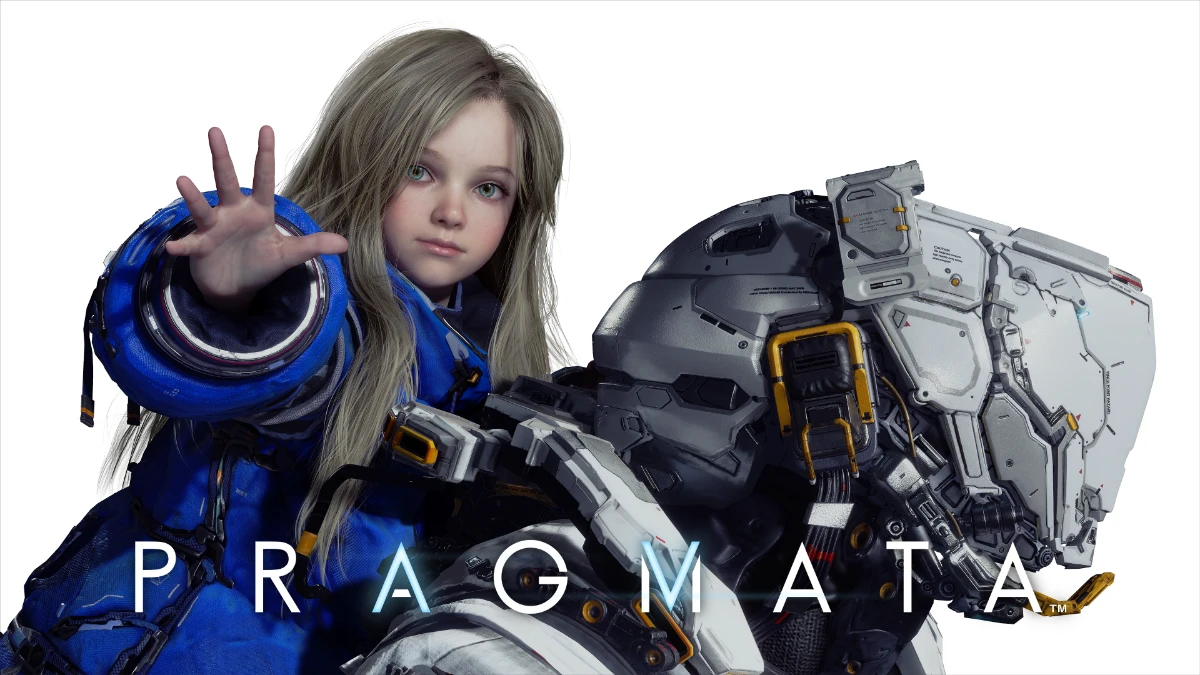
The emotional center is the partnership between Hugh and Diana, and Pragmata understands that this relationship has to work if the rest of the game is going to matter. Hugh begins as a practical, guarded figure, the kind of protagonist who looks built for mission objectives rather than emotional openness. Diana, by contrast, is immediately disarming: childlike in appearance and manner, but clearly far more powerful and perceptive than that first impression suggests.
What makes the pairing effective is that the game does not rely on innocence alone. Diana is not written as a passive mascot, and Hugh is not reduced to a one-note protector. Their bond develops through dependence under pressure, with Hugh needing Diana's hacking ability to survive and Diana needing Hugh's physical presence to navigate escalating danger. That mutual reliance gives the relationship texture, even when the script reaches for familiar surrogate family beats.
Plot Structure And Pacing
Pragmata opens with a strong premise and wastes little time collapsing its apparent order. Hugh arrives at a lunar facility that already feels slightly too polished, slightly too dependent on systems nobody on the ground fully questions, and the game quickly turns that unease into catastrophe. The early disaster sequence is effective because it does not just provide spectacle. It establishes the fragility of the world, the arrogance behind its construction, and the speed with which institutional confidence gives way to survival.
The broader plot is less surprising than its setup. Pragmata follows a fairly recognizable escalation pattern, moving from discovery to pursuit to confrontation in ways genre players will see coming. Even so, the pacing holds because the game keeps feeding the player new pressures through the Hugh and Diana partnership. The story may not constantly surprise, but it rarely loses momentum.
Emotional And Thematic Touchpoints
The game's emotional beats are direct, sometimes almost aggressively so, yet they still land because Capcom commits to the relationship at the center of them. Hugh's protectiveness does not feel like a narrative obligation pasted onto the script. It grows out of repeated moments where Diana's vulnerability and capability exist side by side, forcing him to see her as more than a tool or mission variable.
That same relationship also supports the game's strongest thematic thread. Pragmata is not anti-technology, but it is deeply suspicious of the systems and institutions that ask people to surrender judgment in the name of convenience, scale, or optimization. The moon base, its construction logic, and the AI authority running through it all point toward the same idea: technology without human accountability becomes a threat long before it becomes a miracle. The irony is sharp and intentional. One of the game's warmest relationships is between a man and an artificial being, yet that bond becomes the clearest argument for keeping humanity inside the machine.
Core Gameplay Pillar
On a mechanical level, Pragmata distinguishes itself through the constant interplay between Hugh's shooting and Diana's hacking. Most encounters begin with enemies protected by shields or defenses that make conventional gunfire inefficient. To break that advantage, Diana must hack targets through a rapid grid-based minigame, tracing a route through nodes to reach an exit point while the fight continues in real time.
That structure gives combat its identity. Hugh is not simply waiting for a puzzle to finish, and Diana's hacking is not a detached minigame that pauses the action. The player has to manage incoming pressure, positioning, and evasive movement while also solving the grid quickly enough to create an opening. When the system clicks, the rhythm is excellent: evade, hack, expose, punish, reposition, repeat.

Systems Deep-Dive
The hacking grids become more demanding as enemy types expand, and that escalation is where Pragmata starts to show real confidence. Early encounters teach the basic relationship between shield breaking and damage windows. Later fights complicate that loop with tougher node layouts, more aggressive enemy patterns, and overlapping threats that force faster decision-making.
Hugh's arsenal supports that pressure well. Different weapons create distinct tactical roles rather than serving as simple damage upgrades. Some options are better for staggering enemies and buying Diana time, while others reward close-range commitment or burst damage once a target has been exposed. The result is a combat system built around role differentiation and timing rather than raw firepower alone.
Boss fights push this design further. Hugh's booster movement becomes essential, not decorative, because vertical repositioning and spatial awareness often matter as much as aim. I found the best encounters demanding in exactly the right way: they ask for defensive discipline, quick puzzle recognition, and confident follow-through once a vulnerability window opens. Failure usually feels like a missed read or a rushed input, not a system that has stopped making sense.
Secondary Pillars
Traversal and environmental interaction are lighter than the combat, but they still serve a useful pacing role. The booster adds a welcome sense of mobility outside direct firefights, and the game uses space well enough to make movement feel like part of survival rather than dead time between arenas. Environmental awareness also matters in larger encounters, where cover, elevation, and movement lanes can determine whether Diana has enough breathing room to finish a hack.
The puzzle component is the more distinctive secondary pillar. Because the hacking never fully detaches from combat pressure, it avoids the common problem of feeling like a separate mode awkwardly stapled onto an action game. It remains part of the same tension curve, which is why even repeated encounters retain some bite.
Meta Positioning
Pragmata sits much closer to iterative refinement than outright reinvention, but the thing it is refining is unusual enough to feel fresh. Its third-person shooting foundation is familiar, and its emotional architecture recalls other surrogate-family narratives, including The Last of Us. What separates it is the way those pieces are fused into a combat language that feels distinctly its own.
That matters in a market where large publishers often treat originality as a branding exercise rather than a design priority. Pragmata does not reinvent the action game, but it does take a real swing at combining blockbuster presentation with a stranger, more mechanically specific identity. In that sense, it feels like one of the clearest reminders that Capcom is still at its most interesting when it allows itself to be a little less predictable. It continues a strong Capcom run alongside Resident Evil Requiem.
Frequently Asked Questions
When did Pragmata release?
April 17, 2026, on PlayStation 5, Xbox Series X|S, PC, and Nintendo Switch 2 — a week earlier than Capcom originally announced.
How long is Pragmata?
The campaign runs roughly 15 hours. Our review playthrough covered 12 hours on Standard difficulty on Nintendo Switch 2.
How does Pragmata's combat work?
You control Hugh's third-person shooting while guiding Diana's real-time hacking puzzles to crack open weak points on armored enemies. Bullets alone rarely cut it.
How was Pragmata received?
Strongly: 86 on Metacritic, 97% positive Steam ratings at launch, and over two million units sold in its first 16 days. Our score: 4.0/5.
Verdict
Pragmata succeeds because it commits to both halves of its identity. The Hugh and Diana relationship gives the game emotional momentum, while the shooter-hacking combat loop gives it a mechanical hook strong enough to carry the entire campaign. Its plot can be predictable, and its themes are delivered with more force than finesse, but the confidence of its design keeps those shortcomings from dragging it down. For players who want a big-budget action game that feels willing to experiment, this is one of Capcom's most interesting releases in years.