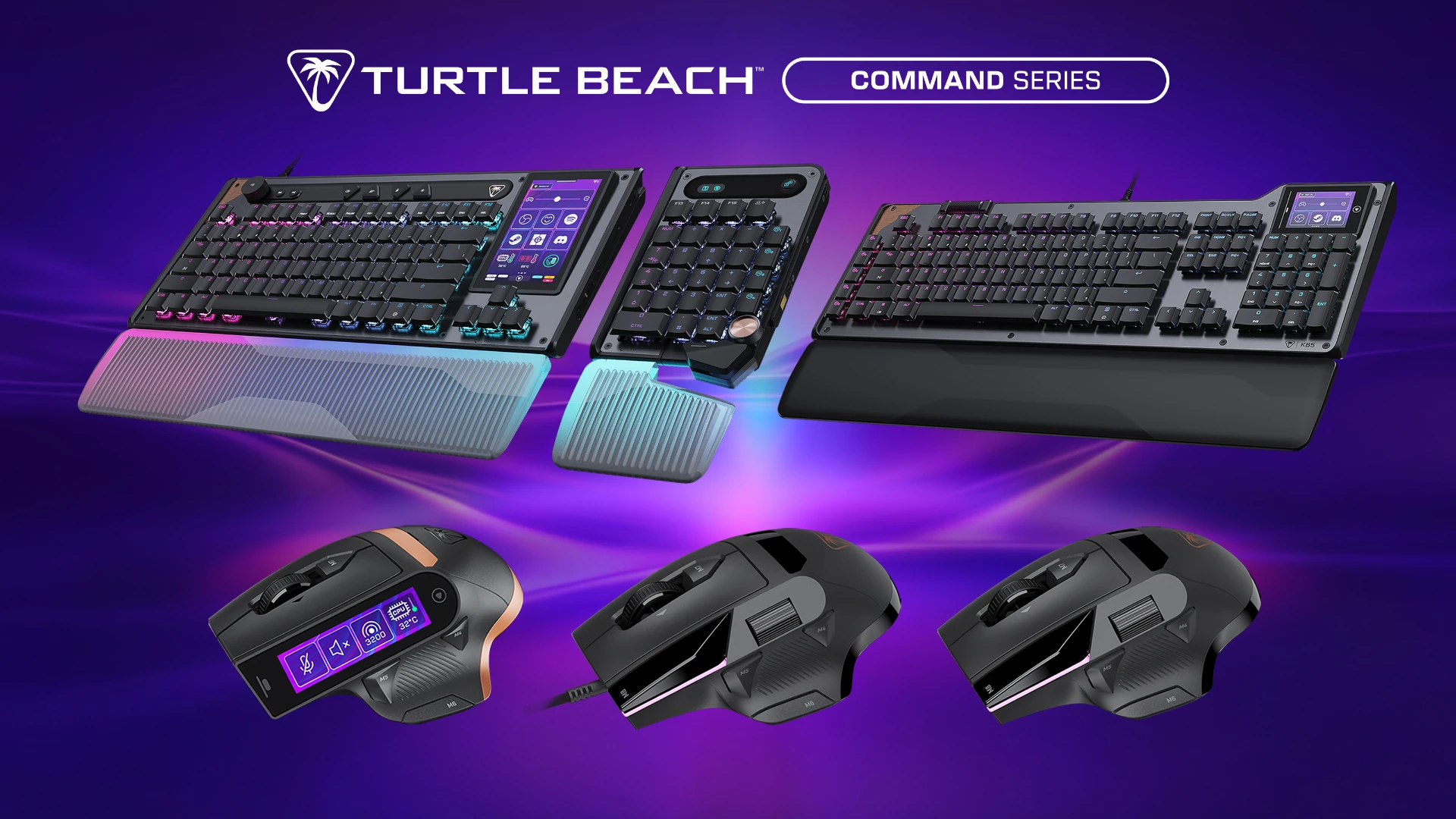

Turtle Beach has announced the new Command Series, a PC peripheral lineup built around integrated touch displays, Hall Effect options, and high polling rates across keyboards, mice, and a modular keypad. Revealed in an April 23 press release, the range includes the KB7 and KB5 keyboards, the KP7 keypad, and three mice led by the MC7 wireless model. Pre-orders are live now through Turtle Beach, with keyboards arriving in May and mice following in July 2026.
Quick Take
Turtle Beach is trying something more ambitious than a routine keyboard and mouse refresh. The Command Series turns small built-in displays into a core part of the experience, giving you direct access to stream controls, macros, system stats, and profile switching without bouncing between apps.
Key Highlights
- KB7 TKL keyboard with a 4.3-inch Command Touch Display
- KB5 full-size keyboard with a 2.4-inch Command Touch Display
- MC7 wireless mouse with its own Command Touch Display
- KP7 modular keypad that docks to the KB7 or works on its own
- Up to 8K polling on the flagship keyboards, keypad, and wireless mice
What We Don't Know Yet
- Canadian pricing and retailer availability
- Full software workflow outside the announced OBS and Streamlabs integrations
- Battery life details for the MC5 beyond Turtle Beach's headline estimate
- How useful the touch displays feel in day-to-day play and work
Key Specifications
| Product | Core Hardware | Standout Feature | Price | Availability |
|---|---|---|---|---|
| KB7 | TKL wired Hall Effect keyboard | 4.3-inch Command Touch Display, 8K polling (manufacturer spec) | $199.99 USD | May 21, 2026 |
| KB5 | Full-size wired mechanical keyboard | 2.4-inch Command Touch Display, 8K polling (manufacturer spec) | $149.99 USD | May 21, 2026 |
| KP7 | Wired modular Hall Effect keypad | KB7 rail docking, Rapid Trigger, 8K polling (manufacturer spec) | $99.99 USD | May 21, 2026 |
| MC7 | Wireless gaming mouse | Command Touch Display, hot-swappable batteries, charging dock | $159.99 USD | July 19, 2026 |
| MC5 | Wireless gaming mouse | 8K wireless polling (manufacturer spec), 29 programmable functions | $119.99 USD | July 19, 2026 |
| MC3 | Wired gaming mouse | Owl-Eye 30K DPI sensor, 29 programmable inputs | $79.99 USD | July 19, 2026 |
What Is the Command Touch Display?
The Command Touch Display is Turtle Beach's new built-in control screen for select keyboards and mice in this lineup. On paper, it gives you direct access to OBS and Streamlabs controls, profile switching, macro triggers, app launches, audio adjustments, and system monitoring from the device itself.
That matters because most gaming peripherals still push these functions into desktop software, extra macro pads, or stream decks. Turtle Beach is betting that putting those controls on the keyboard or mouse shortens the distance between what you want to do and how fast you can do it.
For you, the appeal is simple: fewer alt-tabs, fewer layered menus, and less reaching for a second device when you're gaming, streaming, or editing. Whether that works in practice depends on software polish and how responsive the displays feel, which we still need to test.
KB7 and KB5 Put Streaming Controls on the Keyboard
The KB7 is the flagship of the launch. It uses Titan low-profile Hall Effect switches rated for 100 million keystrokes, adjustable actuation, true 8K polling, per-key RGB lighting, and a 4.3-inch touchscreen built for stream and system controls. Turtle Beach also includes an integrated Action Bar, textured WASD keys, double-shot PBT keycaps, an aluminum-reinforced chassis, and a detachable wrist rest.
Its most interesting hardware feature might be the dual modular rail system. The KB7 can pair directly with the KP7 keypad, which gives the whole lineup more of an ecosystem angle than a one-off flagship keyboard. If you want a desk setup that can shift between competitive play, streaming, and macro-heavy work, that modular approach makes more sense than buying isolated accessories that never quite talk to each other.
The KB5 steps down in price but keeps the same core idea. It swaps Hall Effect switches for Titan low-profile mechanical switches with 1.2mm actuation, trims the display down to 2.4 inches, and adds five dedicated macro keys plus a clickable volume barrel. If you want the touchscreen concept without paying $200, this looks like the more practical entry point.
KP7 Extends the Ecosystem Beyond a Standard Keyboard
The KP7 is a wired Hall Effect keypad that can work as a gaming keypad, macro pad, or numpad. Turtle Beach says it docks to the KB7 through dual modular rails, but it can also run as a standalone device with its own kickstands, detachable wrist rest, programmable scroll wheel, and extendable thumb bar.
This is one of the smarter parts of the announcement. Plenty of brands sell separate macro pads, but the KP7 has a clearer role because it can physically integrate with the flagship keyboard instead of just sitting beside it. If you play MMOs, use a lot of shortcuts in creative apps, or want a more compact left-hand control setup, this is the Command Series accessory that could end up doing the most real work.

MC7, MC5, and MC3 Cover Three Different Mouse Tiers
The MC7 is the headline mouse because it carries the same Command Touch Display idea into a wireless shell. Turtle Beach says you can use that screen to adjust DPI, switch profiles, trigger macros, and control apps without relying on layered software or a pile of extra buttons. The company also claims the MC7 supports OBS control, mic muting, and app launches for streamers and creators.
On the hardware side, the MC7 includes tri-mode connectivity, true 8K polling, an Owl-Eye 30K DPI optical sensor, Titan Optical Switches, an adaptive 4D scroll wheel, 33 programmable functions through Easy-Shift, and dual 1000mAh hot-swappable batteries with a charging dock. Turtle Beach rates each battery for up to 10 hours at full power, or up to 15 hours at 8K with LED and LCD lighting turned off.
The MC5 drops the display and hot-swappable battery system, but it still targets players who want high-end wireless performance. Turtle Beach says it delivers 8K wireless polling, up to 35 hours of battery life, an Owl-Eye 30K DPI optical sensor, Titan Optical Switches, a side scroll barrel, and up to 29 programmable functions.
The MC3 is the wired option. It keeps the Owl-Eye 30K DPI sensor, Titan Optical switches, a 4D scroll wheel, RGB lighting, onboard profiles, and up to 29 programmable inputs, but it runs at 1K polling instead of 8K. At $79.99, it looks like the straightforward pick if you want the sensor and switch package without paying for wireless extras.
Who Should Pay Attention
Streamers and creators
The KB7, KB5, and MC7 are clearly aimed at people who jump between gameplay, scene switching, audio control, and app management. If you already use OBS or Streamlabs, the built-in displays could reduce how often you reach for a separate control surface.
Competitive PC players
The KB7, KP7, MC7, and MC5 all push 8K polling and low-latency positioning. If your priority is fast input and adjustable actuation, the Hall Effect models stand out more than the display features.
Productivity users who want one setup for work and play
Turtle Beach is pitching this lineup beyond gaming, and that part isn't hard to see. Macro triggers, app launches, profile switching, and system monitoring all translate well to editing, streaming, and general desktop work.
Who should wait
If you're curious but not sold on the touchscreen concept, wait for hands-on reviews. The displays are the main differentiator here, and they need to prove they're more than a flashy spec sheet hook.
Competitive Context
Turtle Beach is entering a crowded PC peripheral market where Corsair, Razer, Logitech G, SteelSeries, and HyperX already cover most price tiers. What makes the Command Series stand out is not raw sensor or switch marketing on its own, because plenty of rivals already offer Hall Effect keyboards, high-DPI sensors, and fast wireless polling. The real differentiator is the attempt to merge those specs with built-in touch controls across both keyboards and a mouse.
That could give Turtle Beach a clearer identity in PC peripherals, especially if the software is stable and the displays save time instead of adding friction. Pricing also matters. The KB7 at $199.99 and MC7 at $159.99 place both products in premium territory, so they need to justify themselves against established alternatives that already have mature software ecosystems.
Frequently Asked Questions
What is Turtle Beach Command Series?
The Command Series is Turtle Beach's new PC gaming peripheral lineup. It includes two keyboards, one modular keypad, and three mice, with the KB7, KB5, and MC7 featuring built-in Command Touch Displays.
When do Turtle Beach Command Series keyboards and mice launch?
Turtle Beach says the keyboards and keypad launch globally on May 21, 2026. The mice follow on July 19, 2026. Pre-orders are already live through the company's official store.
How much do the Turtle Beach Command Series products cost?
The announced US prices are $199.99 for the KB7, $149.99 for the KB5, $99.99 for the KP7, $159.99 for the MC7, $119.99 for the MC5, and $79.99 for the MC3.
Which Command Series products have touch displays?
The KB7 TKL keyboard, KB5 full-size keyboard, and MC7 wireless mouse include Command Touch Displays. The KP7, MC5, and MC3 do not.
Is the Turtle Beach Command Series available in Canada?
Turtle Beach has announced global availability windows and listed US, euro, and UK pricing, but it has not shared separate Canadian pricing in the press materials provided here. Canadian retailer listings will likely follow closer to launch.
Looking Ahead
The Command Series is one of the more unusual PC peripheral launches of 2026 so far because Turtle Beach is not just chasing faster switches or a higher DPI number. It is trying to make the keyboard and mouse themselves into control hubs for gaming, streaming, and desktop work.
That idea could land well if the displays are responsive, the integrations are reliable, and the software stays out of your way. If not, the KB7, KB5, and MC7 risk feeling like premium peripherals with expensive party tricks. We'll be watching for hands-on units to see which way this goes.