

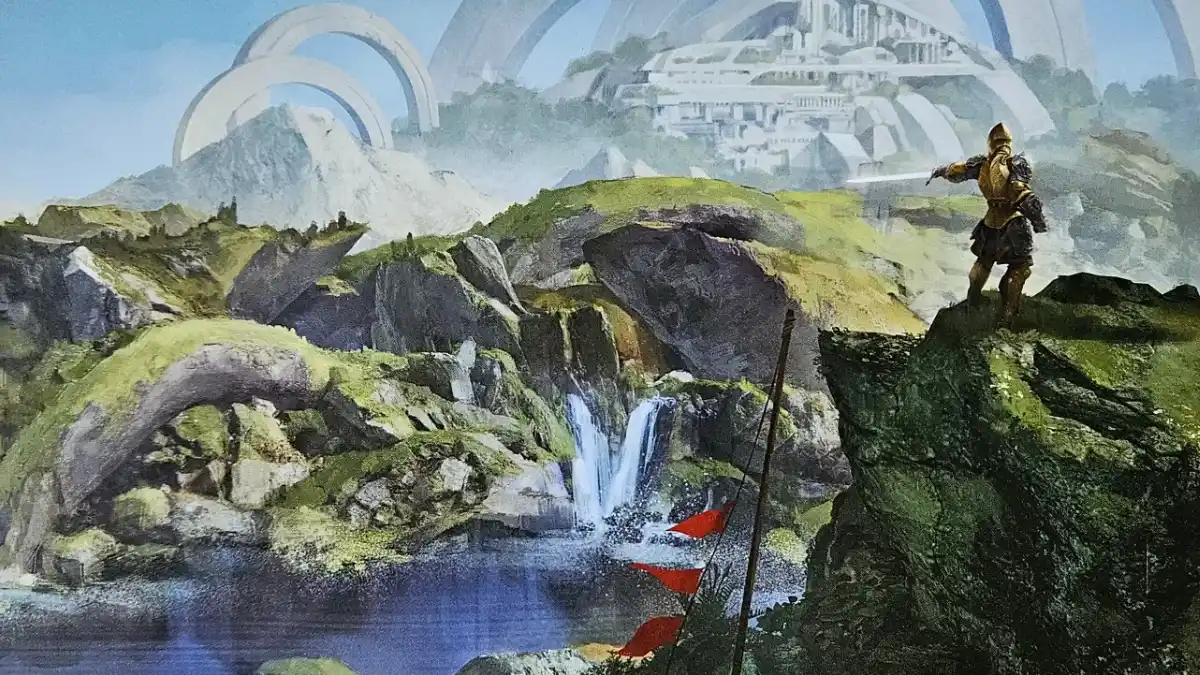

ArenaNet wants you watching the Summer Game Fest on June 5, 2026. If you've been following the breadcrumbs, you already know why. If you haven't, let's walk through them.
Summer Game Fest has become the industry's biggest mid-year stage, the place where publishers drop trailers that set the conversation for the rest of the year. It's where you announce a new mainline entry, not where you promote a patch. ArenaNet knows this. And choosing this venue, with this little notice, tells you something about how confident they are in whatever they're about to show.
The studio posted a teaser clip on X on the afternoon of June 4, roughly 24 hours before the show. The clip is short. A few seconds of atmospheric footage. No gameplay. No logo. No explicit mention of any specific franchise. Just a message: “Get ready — and tune in on June 05, 2026, at the Summer Game Fest. Something big is brewing in the #Games industry. Will you be there?”
“Something big” carries a lot of weight in three words. But for anyone who's tracked ArenaNet's moves since early 2024, the subtext isn't exactly subtle. The studio has been laying track toward this moment for more than two years, and the only question left is whether they can stick the landing.
Three candidates. Two of them don't fit the stage.
ArenaNet currently has three known projects in motion. Let's go through them, because the exercise of elimination is what makes the Summer Game Fest appearance so revealing.
Guild Wars Reforged and the mobile port
Earlier this year, ArenaNet gave the original 2005 Guild Wars a new coat of paint with the Reforged remaster. It was a welcome update (cleaner textures, modern resolution support, some quality-of-life tweaks) but it was fundamentally a preservation effort aimed at the game's existing community. A mobile port of Guild Wars is also lined up for later this summer, targeting the kind of on-the-go audience that the original game was never built for.
Both of these are real projects with real audiences, but neither of them belongs on the main stage at Summer Game Fest. The Reforged remaster already had its announcement window. The mobile port was revealed separately and targets a niche that doesn't overlap much with the global livestream audience. ArenaNet is not going to use a prime Summer Game Fest slot (the same stage where publishers unveil their biggest upcoming titles) to reheat a mobile port that was already announced months ago. That would be a mismatch of venue and content so severe it borders on self-sabotage.
The next Guild Wars 2 expansion
Guild Wars 2 is almost certainly gearing up for its next expansion. The team has settled into a steady rhythm over the past few years, and both Janthir Wilds and Visions of Eternity followed a pattern: reveals in June or July, with detailed livestreams, blog posts, and community events built around each announcement. ArenaNet has gotten good at this cadence, and the Guild Wars 2 audience knows what to expect from it.
But expansions for a live game don't eat a slot at the industry's biggest summer showcase. They get their own dedicated streams, controlled environments where the developers can spend 45 minutes walking through features, answering questions, and speaking directly to their existing players. The Summer Game Fest main stage is not built for that kind of conversation. It's built for broad-strokes announcements that make people who've never played a Guild Wars game sit up and pay attention. A GW2 expansion reveal doesn't need that reach. It needs depth, not spectacle.
Guild Wars 3
That leaves Guild Wars 3. NCSoft confirmed the project was in development during an investor call in March 2024, which makes this one of the worst-kept secrets in the MMO space. More than two years have passed since that confirmation, and two years is a meaningful stretch of development time for a studio that has been quietly, but visibly, staffing up.
ArenaNet's job listings have been the most consistent signal. Over the past two years, the studio has posted multiple roles for what it describes as an “unannounced AAA project” built in Unreal Engine 5. One listing in particular caught attention: a sandbox designer role that asked for experience with live-service games, MMORPGs, or early-access titles. That's not the résumé you write for a maintenance patch, a side project, or even an expansion. That's the job description for building a new world from scratch.
You can read more about the hiring trail in our earlier coverage of ArenaNet's unannounced project, but the short version is this: the patterns have been pointing in one direction for a while now. The Summer Game Fest teaser doesn't create new evidence so much as it confirms what the existing evidence already suggested.
This is still speculation. ArenaNet could walk onto the stage and announce something none of us predicted. But when you line up the timing (two years since the NCSoft confirmation) with the venue, the hiring patterns, the engine choice, and the tone of the teaser itself, Guild Wars 3 is the only candidate that earns a stage this size.
Why Summer Game Fest, and why now?
The venue matters as much as the announcement. ArenaNet could have revealed Guild Wars 3 on its own terms: a dedicated livestream, a blog post, a carefully produced teaser dropped on YouTube with no external pressure. That's how the studio has historically operated. Guild Wars 2's expansions were all announced through ArenaNet's own channels, with the community gathered around the studio's Twitch page rather than a third-party showcase.
Choosing Summer Game Fest instead signals something different. It means ArenaNet wants this announcement to land outside the existing Guild Wars community. It means they're aiming for the same audience that watches for news about the next Final Fantasy, the next Elden Ring project, the next big thing from whoever has a stage slot. This is a reach play, an attempt to put Guild Wars back into the broader conversation about where the MMO genre is going, not just where one studio's live-service game is headed next.
The timing also lines up with a moment of transition in the MMO landscape. World of Warcraft continues its expansion cadence, but the audience for something genuinely new (not a remaster, not an expansion, but a fresh world built with modern tools) hasn't had many options in recent years. Final Fantasy XIV remains the closest comparison point in terms of scope and ambition, but even that game is now more than a decade old. A new Guild Wars, built from scratch in Unreal Engine 5 and designed with a decade and a half of lessons learned from GW2, would enter a market that looks very different from the one Guild Wars 2 launched into in 2012.

Hype, hope, and a little bit of dread
The reaction on X split cleanly between excitement and anxiety. That split is worth paying attention to, because it tells you something about the relationship Guild Wars players have with this franchise and with game announcements in general.
ExplosiveBolts put the anxiety side bluntly: “This better not be some stupid card game.” It's a funny line, but the laughter covers real scar tissue. The gaming industry has a long history of teasing major franchise announcements that turn out to be mobile spin-offs, companion apps, or genre pivots nobody asked for. When a studio says “something big” without naming the thing, fans have learned to brace for the worst.
Others are already worrying about what a sequel means for the game they're currently playing. SharkyNerd wrote: “As exciting as a GW3 would be … I fear it would decimate the player base of GW2 and make the in-game content even harder to manage.” This is not an abstract concern. MMO populations are zero-sum in practice: every player who migrates to the sequel is one fewer body in the existing game's open-world events, dungeon queues, and guild rosters. ArenaNet has kept GW2 running for more than a decade by maintaining a stable player base. A GW3 announcement raises real questions about how the studio plans to support two live MMOs simultaneously.
On the optimism side, Hasiobard pointed to the venue itself as the strongest signal: “I believe it has to be GW3 — to announce it at the game fair is a huge deal, so I would feel like: Is that it? But a new game that is currently in the works and large enough for the game fair.” The logic here is sound. If ArenaNet booked a Summer Game Fest slot for something smaller than a new mainline entry, the audience reaction would be swift and punishing. The venue creates expectations, and those expectations act as a constraint on what the announcement can reasonably be.
Guillejin summed up both the hope and the risk: “If it's not Guild Wars 3, they will disappoint all the people who expect just that, and I hope it's created in Unreal Engine 6.” UE6 doesn't exist yet, which makes the line playful, but the underlying point is serious. ArenaNet's teaser has already done its work: it has planted Guild Wars 3 in enough minds that any other announcement will feel like a letdown. The studio is now committed to delivering something that matches the weight of expectations it deliberately created.
What's striking about these reactions is how little variation there is in the interpretation. The community isn't debating whether the teaser points to GW3. The debate is about what GW3 means for GW2, whether ArenaNet can pull it off, and how badly it would sting if they can't. That kind of unified read on an ambiguous teaser is itself a signal: the fanbase has been waiting for this specific announcement long enough that a three-word hint was all it took.
What we actually know about Guild Wars 3
Almost nothing. Let's be honest about that.
NCSoft's investor confirmation in March 2024 gave us the name (Guild Wars 3 is in development) and not much else. No release window. No platforms. No setting. No details about combat, classes, monetization, or scope. The confirmation itself was a single line in an investor presentation, shared not because NCSoft wanted to announce the game but because publicly traded companies have to disclose material projects to shareholders.
Since then, ArenaNet's public job listings have been the only window into what the studio is building. Those listings paint a partial picture: an Unreal Engine 5 project, a sandbox designer experienced with live-service games, roles across multiple disciplines that suggest a full production pipeline rather than early pre-production. The pieces match the shape of an MMO sequel, and the engine choice alone signals ambition. Unreal Engine 5 is not cheap to develop in, but it opens doors for visual fidelity and open-world scale that Guild Wars 2's proprietary engine was never going to match.
But job listings are tea leaves, not roadmaps. They tell you what skills a studio is hiring for, not what the finished product will look like or when it will arrive. ArenaNet has been careful to keep the actual project under wraps, and the studio's public statements have been limited to the NCSoft investor disclosure and a handful of vaguely worded career page descriptions. No developers have given interviews about GW3. No concept art has leaked. No closed alpha sign-ups have appeared. By the standards of the modern games industry, where nearly every major project gets a partial leak before its official reveal, Guild Wars 3 has been remarkably quiet.
That silence could mean several things. It could mean the project is earlier in development than the two-year timeline suggests and ArenaNet simply doesn't have much to show yet. It could mean the studio has run an unusually tight ship on internal secrecy. Or it could mean that whatever they're about to show at Summer Game Fest represents the first real glimpse of a game that has been in development for longer than anyone outside the studio realizes.
What's at stake
Guild Wars occupies a strange position in the MMO landscape. It has never been the biggest game in the genre (World of Warcraft and Final Fantasy XIV have traded that title for years), but it has also never quite faded into the background the way so many MMOs from the 2000s and early 2010s eventually did. Guild Wars 2 found an audience by refusing to copy the subscription model, by designing open-world content that rewarded cooperation instead of competition, and by building a combat system that felt faster and more fluid than the tab-targeting norm.
A sequel gives ArenaNet the chance to modernize all of that (the engine, the systems, the visual language, the onboarding experience for new players) without dragging a decade of legacy code behind it. It also gives the studio a chance to introduce Guild Wars to players who were too young to care when the first game launched in 2005, and to console players who've never had a native Guild Wars experience at all.
The risk, as the community reactions already make clear, is what happens to Guild Wars 2. MMOs are sticky by design. Players invest years into characters, guilds, achievements, and social networks. A sequel doesn't just compete for attention; it divides it. ArenaNet has not said anything publicly about how it plans to support both games, and that silence will become harder to maintain once GW3 is officially real rather than an open secret.
What we don't know, and what we're watching for
Beyond the obvious questions (release date, pricing, platforms) there are deeper unknowns that will shape how the announcement lands:
Combat philosophy. Guild Wars 2's combat was one of its strongest calling cards, blending action-oriented movement with buildcraft depth. Will GW3 iterate on that system or start fresh? The UE5 engine choice suggests the latter might be more practical, but players will want to know whether the fluid, movement-heavy feel that defined GW2 carries forward.
Monetization model. Guild Wars carved out its identity by rejecting the subscription model that dominated the genre. GW3 lands in a world where battle passes, cosmetic shops, and expansions are the norm, and where players are more skeptical of monetization than ever. How ArenaNet navigates this will set the tone for the game's relationship with its community before anyone has even logged in.
Platform strategy. A PC-only launch would be the safe, expected path. But if ArenaNet is building in UE5 and aiming for a Summer Game Fest audience, the possibility of a console announcement (maybe even a simultaneous PC and console launch) is worth watching for. The MMO genre has been inching toward console for years. Final Fantasy XIV proved it works. A Guild Wars game that launches on PlayStation alongside PC would be a genuine shift in strategy and a signal about the size of the audience ArenaNet is chasing.
GW2's future. This might be the most important question for the existing player base, and it's the one ArenaNet has been most careful not to answer. Will GW2 continue to get expansions after GW3 launches? Will the two games coexist with separate development teams, or will resources shift toward the sequel? The studio's answer, or its silence, will determine whether the GW3 announcement feels like a celebration or a funeral for a game people are still actively playing.
The bottom line
ArenaNet is bringing something big to Summer Game Fest, and the smart money, backed by two years of investor disclosures, job listings, and community expectations, is on Guild Wars 3.
The teaser is short. The community is ready. The only thing left is for the studio to show its hand.
We'll find out on June 5.


