

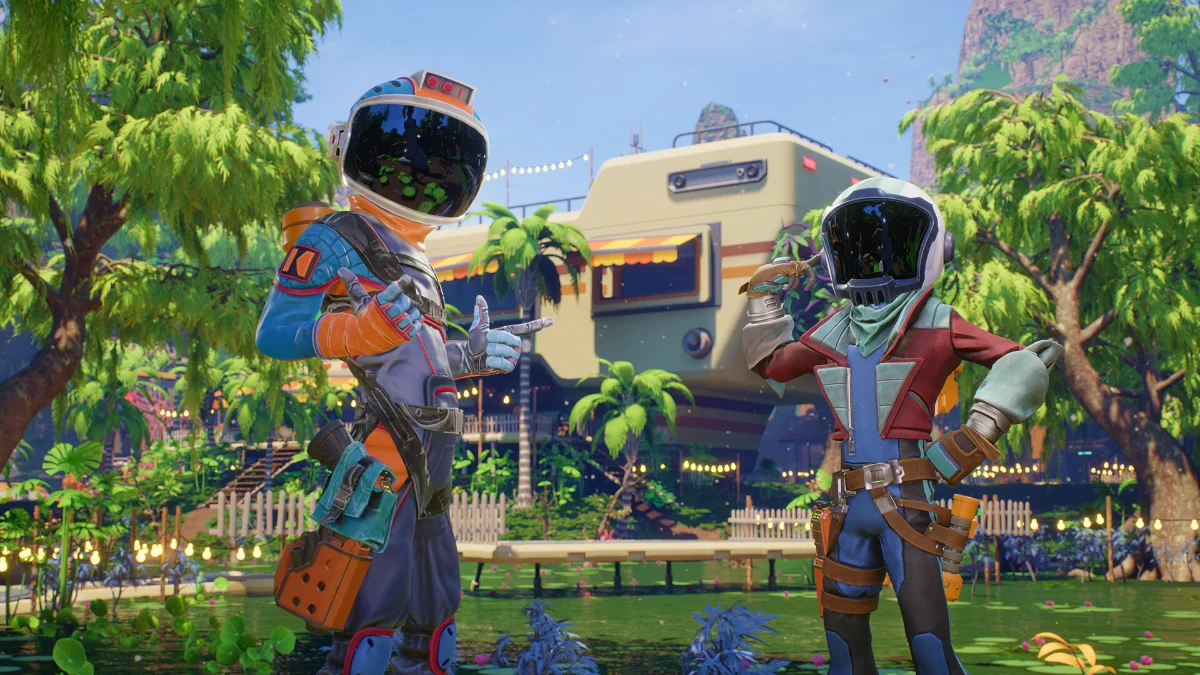

Revenge of the Savage Planet is the rare sequel that benefits from not pretending it has outgrown its own identity. Raccoon Logic does not chase prestige, scale for its own sake, or the kind of self-serious reinvention that often flattens a distinctive original into something more generic. Instead, it returns to the same acidic mix of sci-fi exploration, slapstick danger, and corporate satire that made Journey to the Savage Planet memorable, then sharpens the edges. The result is a follow-up that feels more confident than transformative, but also more focused, funnier, and more comfortable in its own skin.
That confidence matters because this is a game built on a very specific tone. Revenge of the Savage Planet is not interested in presenting space as majestic or mysterious in the traditional sense. Its universe is colourful, ridiculous, and spiritually owned by the sort of corporation that would describe abandonment as a staffing adjustment. That premise gives the sequel a stronger voice than many larger games with bigger budgets and less personality. Even when individual systems stay fairly light, the game rarely feels directionless because its writing, art direction, and progression loop are all serving the same idea.
Satire With Teeth
The setup lands quickly and cleanly. You arrive on an alien world under the banner of Alta, a mega-corporation whose entire presence suggests that human resources should probably be classified as a hostile biome, only to discover that you have effectively been discarded and left to sort things out yourself. It is a strong opening because it does not waste time pretending this is a noble frontier adventure. You are not here to build a better future. You are here because a company made a decision and somebody lower down the chain had to absorb the consequences.
That framing gives the sequel's humour more bite than the original. Journey to the Savage Planet was already funny, but Revenge of the Savage Planet is more pointed in how it uses comedy to define the world. The fake adverts, FMV interruptions, internal messages, and corporate spin are not just jokes between missions. They are the architecture of the setting. Every absurd commercial and every piece of executive nonsense reinforces the same idea: this is a universe where exploitation has been polished into branding.
The best satire here works because it is only a few steps removed from plausibility. A grotesque food ad, a self-help scam dressed up as aspiration, and the endless language of corporate deflection all feel exaggerated by degree rather than by category. Even when the game is being deliberately stupid, it is usually being stupid with purpose.
A Better Looking Mess
Visually, Revenge of the Savage Planet sticks with the bright pulp sci-fi identity of the first game, but it uses that style more effectively. The planets are vivid, dense, and easy to read at a glance, with exaggerated silhouettes and loud colour contrast doing a lot of the work. That clarity matters because the game wants you to be curious. A good area in Revenge of the Savage Planet does not just look attractive. It suggests that something is hidden, something is dangerous, or ideally both.
The worlds are not huge, and that is one of the sequel's smartest decisions. Rather than stretching itself into open-world bloat, the game builds compact spaces with enough verticality, tucked-away resources, and suspicious side routes to keep you constantly glancing away from the objective marker. You are rarely moving through empty terrain. More often, you are spotting a ledge that looks reachable later, a cave that seems too deliberate to ignore, or a creature that appears to be guarding something useful. That density gives exploration a strong rhythm and keeps the game from feeling padded.
The shift to third-person is the biggest structural change, and it takes a little time to settle. The original game's first-person view gave scanning and surprise encounters a more intimate feel, and some of that immediacy is lost here. Early on, the new perspective can make the sequel feel slightly less tactile than its predecessor. Over time, though, the benefits become obvious. Platforming is easier to judge, combat spaces are easier to parse, and the broader framing gives the game more room for physical comedy. The protagonist's absurd run animation is not just a throwaway gag. It is a statement of intent.
Exploration Does the Heavy Lifting
For all its jokes and presentation flair, Revenge of the Savage Planet is still fundamentally an exploration game. Its structure is recognisably Metroidvania, with progress gated by tools, upgrades, and environmental permissions, but it spreads that structure across multiple planetary maps rather than one tightly interlocked world. That makes the game feel breezier than some of its genre peers, though not necessarily thinner. The pleasure comes from the loop of noticing a barrier, filing it away, unlocking a new ability, and then returning to turn a previously decorative corner of the map into something useful.
What the sequel does especially well is make exploration feel impulsive. You are not just clearing icons or following a checklist. You are responding to visual suggestions. A ledge that looks slightly too neat, a resource cluster perched somewhere awkward, or a route half-hidden behind alien foliage can all become reasons to abandon the main objective for a few minutes. That kind of design is easy to underestimate. It depends on spaces being readable without becoming obvious, and Revenge of the Savage Planet usually gets that balance right.
The upgrade loop supports that structure nicely. New tools rarely feel isolated from the rest of the game. A traversal ability might also open a hidden route, expose a collectible path, or change how you approach a creature encounter. That overlap keeps the design cohesive. Exploration, combat, and progression are not separate tracks so much as different expressions of the same forward motion. The game is also smart enough not to drown that loop in unnecessary complexity. There are enough unlocks to keep momentum alive, but not so many that the whole thing turns into menu management.
Movement helps a great deal. Traversal has a springy, low-friction quality that makes detours feel attractive rather than inconvenient. Even when the reward at the end of a route is modest, getting there often feels worthwhile because the spaces are arranged to keep your eye wandering. That is one of the sequel's quiet strengths. It understands that exploration only works if moving through the world is pleasurable on its own terms.

Combat Keeps Things Moving
Combat is less ambitious than the exploration, but it is solid enough to support the rest of the game. Most encounters are built around mobility, target prioritisation, and using your tools efficiently while the environment tries to complicate matters. Enemies are expressive enough that their attacks can be read quickly, and the feedback from weapons, impacts, and creature reactions keeps fights lively. There is a pleasing messiness to the action, especially when the screen fills with goo, panic, and bad decisions.
Still, this is not where Revenge of the Savage Planet reaches its highest ceiling. The combat is responsive and amusing, but rarely demanding. The game is more interested in maintaining momentum than in forcing mastery, and that means the challenge level stays fairly gentle for long stretches. For a title full of hostile wildlife and environmental hazards, it can be surprisingly relaxed. That softness is not necessarily a flaw. It keeps the game inviting and prevents frustration from overwhelming the tone. It does, however, mean that some encounters blur together because the systems are not pushed hard enough to create memorable spikes in tension.
That same generosity shapes the broader experience. Revenge of the Savage Planet often feels more interested in keeping you curious than in keeping you under pressure. Players looking for a harsher combat loop or a more exacting mastery curve may find it a little too forgiving.
Co-op Fits Naturally
The entire campaign can be played in co-op, either online or in split-screen, and the game is naturally suited to it. Savage Planet has always had a streak of slapstick in its design, and another player turns many of its best moments into shared disasters. A mistimed jump, a panicked retreat from an oversized alien creature, or a badly coordinated fight becomes funnier when somebody else is directly implicated in the failure.
Co-op also reinforces the game's broader tone. This is a story about being abandoned by a corporation and left to improvise with whatever tools and dignity remain, so tackling that mess with another player feels thematically appropriate. The mode is not flawless. You cannot freely split up across planets, progression is tied to one player's save, and the session flow is not as seamless as a true drop-in, drop-out structure would be.
Even so, the mode adds more than it subtracts. The humour is stronger when it has an audience, and the systems are loose enough to support collaborative chaos without collapsing into confusion. Solo play works perfectly well, but co-op often feels like the version of the game that most naturally matches its personality.
Texture Over Scale
One of the sequel's smartest choices is that it never mistakes size for richness. The worlds are not massive, but they feel inhabited because the game keeps layering them with texture. Corporate emails, absurd broadcasts, FMV segments, environmental details, and creature design all contribute to a setting that feels specific rather than generic. Even when optional content is mechanically simple, it still tends to carry tonal value. You are not always uncovering a major gameplay reward. Sometimes you are just finding another piece of this universe's deeply broken logic.
That texture is what keeps the game from feeling slight. Strip away the writing and presentation, and the underlying structure is efficient but familiar. With them in place, the whole thing gains personality. Revenge of the Savage Planet does not need every side path to contain a revelation. It just needs enough flavour that wandering off course remains rewarding, and for the most part it achieves that.
There are some technical blemishes that interrupt the flow. Collision can be unreliable, and there are moments where an ability or interaction does not behave as cleanly as it should. None of these issues are severe enough to sink the experience, but they are noticeable because the game depends so heavily on rhythm. When traversal and experimentation are central pleasures, even small hitches stand out more than they would in a slower game.
Final Verdict
Revenge of the Savage Planet succeeds because it knows exactly where its strengths live. It sharpens the original game's satire, builds denser and more inviting spaces to explore, and trusts a compact progression loop to carry the experience without overcomplicating it. The third-person shift takes some getting used to, and the combat rarely pushes beyond competent, but the game's voice is strong enough to make those compromises easy to accept.
This is an iterative sequel in the best sense. It trims friction, returns with a clearer personality, and understands that curiosity can be a stronger hook than sheer scale. While it can be a little too forgiving and a little rough around the edges, its world remains a pleasure to poke at, its jokes land more often than they miss, and its exploration loop keeps momentum alive from one planet to the next.


