
Guild Wars 2’s fifth expansion shifts to a yearly release cadence with smaller scope and lower price point. Janthir Wilds trades the sprawling verticality of Secrets of the Obscure for landlocked maps designed around Warclaw traversal, adds land-based spears for all classes, and introduces Homestead, a customizable housing system with meaningful progression buffs. The expansion’s story improves significantly over its predecessor, delivering satisfying narrative beats centered on bear-focused lore without the ethereal abstraction that plagued SoTO. Two new maps feel more navigable than previous sky-focused zones, though meta event synchronization issues persist.
The Homestead system offers genuine customization depth for players interested in decoration, while its mastery track provides an eight percent Magic Find and PVP/WvW track buff that makes progression feel mandatory rather than optional.Land spears add weapon variety without replacing established builds, and the new Push PVP mode condenses matches into two to six-minute objective tug-of-war scenarios. Rift hunts return with identical structure to SoTO’s implementation, remaining tedious resource grinds. For Guild Wars 2’s horizontal progression philosophy, Janthir Wilds succeeds as an optional expansion that adds variety without creating power gaps. Veterans gain new toys and housing systems. New players can skip it entirely and access 12 years of horizontal content through the free base game without falling behind.
Expansion Model Shift and Scope Recalibration
ArenaNet announced a strategic pivot with Secrets of the Obscure: yearly expansions with smaller content footprints and reduced pricing. Janthir Wilds represents the second iteration of this model. Previous expansions like Heart of Thorns and Path of Fire delivered massive map counts, elite specializations for all nine professions, and systemic overhauls. Janthir Wilds narrows focus to two maps, one new weapon type (land spears), Homestead housing, continued Secrets of the Obscure systems (rift hunts, convergences), and a single PVP mode.
The reduced scope aligns with Guild Wars 2’s horizontal progression design. Players who own Path of Fire and Heart of Thorns unlock all elite specializations and core endgame systems. Janthir Wilds adds variety and quality-of-life improvements without creating mandatory power creep. This approach works for a 12-year-old MMO where vertical gear treadmills would alienate the playerbase.
Price scales accordingly. Janthir Wilds launched at a lower Buy-to-Play price point than Heart of Thorns or Path of Fire. For players measuring entertainment hours per dollar against other MMO subscriptions or $70 AAA releases, the value proposition remains competitive. Whether that value justifies purchase depends on interest in Homestead, spear weapons, and narrative continuation rather than mandatory progression gates.
Story Acts: Bear-Focused Narrative Beats
Janthir Wilds’ story centers on Tyrian bears and their connection to the Kodan culture, moving away from Secrets of the Obscure’s cosmic abstraction toward grounded character arcs. The narrative improves pacing and stakes clarity compared to SoTO’s ethereal Kryptis conflicts. Bear factions, their internal political tensions, and their role in Tyrian history receive focused development without sprawling into tangential plotlines.
Story missions avoid the mission structure bloat that plagued Living World Season 1’s revival. Objectives stay clear. Pacing maintains momentum without filler padding between key narrative beats. Voice acting quality remains consistent with Guild Wars 2’s established standard, delivering emotional weight during critical character moments.
The expansion forces players to complete heart quests and mastery unlocks mid-story, gating narrative progress behind open-world grinding. This design choice disrupts pacing for players who prefer separating story consumption from exploration loops. The gate exists to ensure players engage with map mechanics and mastery systems, but it treats story as tutorial vehicle rather than standalone experience.
Narrative threads from End of Dragons remain unresolved. Aurene’s fate after returning magic to Tyria’s ley lines goes unaddressed. No story missions revisit her status or the long-term implications of her sacrifice. This creates narrative gap for players invested in elder dragon storylines, though ArenaNet may address this in future Living World episodes if the studio returns to that release model.
Janthir Wilds introduces two maps: Lowland Shores and (second map name). Both prioritize ground-based traversal over Skyscale verticality, designing encounter spaces and event chains around Warclaw mobility. The shift makes navigation more intuitive for players without fully upgraded Skyscales, though Skyscale remains the most efficient mount for bypassing terrain obstacles.
Maps use traditional Guild Wars 2 layering: dynamic events trigger across multiple zones simultaneously, meta event chains build toward zone-wide boss encounters, and heart quests provide repeatable objectives for mastery experience. Environmental variety comes from biome transitions within maps rather than vertical stratification. Forests transition into wetlands, craggy cliffsides give way to bear settlements, and event density remains high enough to stumble into content without consulting timers.
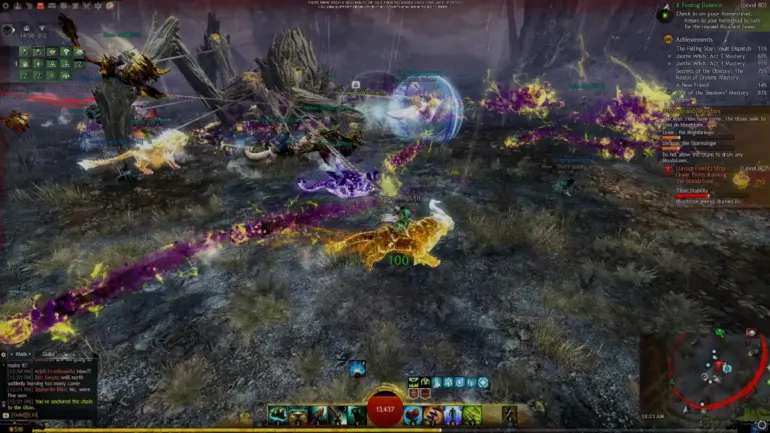
Meta events suffer from synchronization requirements common to Guild Wars 2’s design. Multiple bosses spawn simultaneously across the map with identical kill windows. If squads fail to coordinate damage output and kill bosses within seconds of each other, the meta fails. This mechanic punishes uncoordinated public groups and creates frustration when one subgroup underperforms. I participated in dozens of meta attempts with roughly 50 percent success rate, failures typically caused by boss health desync rather than squad wipes.
The simultaneous kill mechanic appears in Heart of Thorns (Tangled Depths), Path of Fire (various bounty chains), and persists here without iteration. Commander coordination through map chat becomes mandatory, but public squads lack voice communication tools that would make split-squad coordination feasible. The design assumes organized guild runs or coordinated PUGs, alienating casual players who join events mid-progress.
Homestead: Housing System with Progression Incentive
Homestead introduces instanced player housing with extensive customization tools. Players receive personal plots with adjustable terrain, placeable structures, decorative objects sourced from achievement rewards and Trading Post purchases, and one-button harvesting for home instance resource nodes. The system rivals Final Fantasy XIV’s housing customization depth while avoiding that game’s limited plot availability crisis through instanced plots for all players.
Homestead’s mastery track provides an eight percent Magic Find buff and eight percent PVP/WvW track progress increase at maximum rank. These buffs apply globally, not just within Homestead instances. The Magic Find bonus affects all loot drops across the game, making the mastery track feel mandatory for players who farm gold through open-world events, fractals, or meta chains. PVP and WvW players gain faster reward track completion, reducing grind for legendary precursors and ascended gear.
The mandatory feeling undermines Homestead as optional content. Rather than engaging with housing because decoration interests you, the mastery track incentivizes grinding Homestead experience purely for numerical advantages. Players who dislike housing systems face a choice: skip eight percent efficiency gains or spend hours decorating spaces they don’t care about to unlock masteries.
Home instance harvesting receives quality-of-life improvements. A single keybind harvests all nodes of one type (plants, wood, ore) across the entire instance using your selected gathering tool’s glyph. This condenses five-minute daily harvesting loops into 30-second cycles. For players with fully upgraded home instances (gained through Living World episode completion and gemstore purchases), the time savings add up across hundreds of daily login sessions.
Community creativity with Homestead decoration tools produces impressive results visible through player-shared screenshots on Guild Wars 2 subreddits. Custom jumping puzzles, thematic crypts, and elaborate gardens demonstrate the system’s flexibility. The tools support this creativity without the object count limits that plague some competitor housing systems, though performance drops occur in heavily decorated instances on lower-end hardware.
Land Spears: Weapon Variety Without Build Revolution
Land spears expand weapon options for all nine professions, adding a two-handed melee option with unique skill sets per class. Each profession’s spear skills fit thematic niches: Guardian gains supportive blocks and group buffs, Necromancer applies conditions through chained attacks, Ranger uses pet synergy skills, and Revenant channels legend-specific abilities through spear combos.
I tested spears extensively on Necromancer, Ranger, Guardian, and Revenant across PVP and open-world PVE contexts. In PVP, spears offer alternative playstyles without replacing meta builds. Guardian spear skills require activating skill five first to empower skills two through four, creating predictable combo sequences that experienced opponents read easily. This telegraphing limits spear Guardian’s effectiveness against skilled players who recognize the setup pattern.
Revenant spear feels more fluid, allowing skill rotation flexibility without mandatory setup requirements. Necromancer spear applies conditions reliably but lacks the burst damage or sustain that makes core Necromancer builds dominant in conquest mode. Ranger spear integrates pet abilities into combos smoothly, though pet AI responsiveness remains inconsistent during chaotic teamfights.
In open-world PVE, spears function as stat sticks with flashy animations. Damage output matches other weapon options without outperforming established meta builds. Spear skills lack the cleave efficiency of greatswords or the ranged safety of longbows, placing them in a middle-ground niche for players who prioritize visual variety over optimization.
Skin availability remains limited at launch. Legendary spear releases in November 2024 according to ArenaNet announcements, leaving players with basic skins and the Meteor Spear from Wizard’s Vault as primary cosmetic options. The Meteor Spear requires completing a short story chain for ascended quality, providing thematic flavor but limited visual variety compared to established weapon types with hundreds of skins accumulated over 12 years.
Mastery Progression and Warclaw Revamp
Janthir Wilds adds mastery tracks totaling approximately 15 to 20 masteries split between Homestead, Warclaw PVE abilities, and zone-specific mechanics. Maximum mastery level across all expansions reaches 600 with Janthir Wilds included. Experience requirements per mastery track sit in the low millions, making completion achievable through casual open-world event participation over weeks rather than months-long grinds.
Warclaw receives PVE-specific upgrades unavailable in WvW. The mount gains limited flight capability through short glide bursts, fall damage negation from any height, and combat skills usable during specific boss encounters and meta events. These abilities remain locked to Janthir Wilds maps, preventing power creep in older content where Warclaw would trivialize jumping puzzles or exploration challenges balanced around Raptor and Springer mobility.
The revamp makes Warclaw relevant outside WvW for the first time since its Path of Fire introduction. Previously, Warclaw functioned solely as a WvW mount with situational combat utility. Players who unlocked it through the tedious WvW reward track rarely used it in PVE because Raptor offered better speed, Springer handled verticality, and Skyscale trivialized exploration. Janthir Wilds maps design encounters that require Warclaw specifically, forcing adoption through mechanical necessity rather than optional preference.
This creates friction for players who dislike mount-required mechanics. Guild Wars 2 historically allowed players to complete content with any mount or none at all (excluding specific mastery-gated zones like high-altitude Skyscale areas). Janthir Wilds introduces bosses with mechanics that become impossible without Warclaw’s combat skills, gating participation behind mount ownership. Players who purchased Janthir Wilds without Path of Fire (which unlocks Warclaw through WvW) face an additional expansion purchase or weeks of WvW grinding to access content they paid for.
ArenaNet addresses this by unlocking Warclaw for all Janthir Wilds owners, but the precedent of mount-mandatory mechanics represents design shift away from Guild Wars 2’s traditional horizontal accessibility philosophy.
Rift Hunts: Tedious Resource Extraction Continues
Rift hunts return from Secrets of the Obscure with identical structure and identical problems. The gameplay loop remains:
- Activate rift scan skill
- Waypoint to nearest rift location
- Engage rift by clearing trash mobs or joining in-progress encounters
- Kill elite or champion enemy that spawns from rift
- Close rift, collect rewards (essences and tier-specific materials)
- Repeat
Tier 2 and Tier 3 rifts require crafting Motivation consumables using lower-tier materials or Trading Post gold. Higher tiers offer better essence drop rates for legendary armor crafting but demand identical mechanical engagement to Tier 1. No additional challenge, complexity, or variety emerges. You complete more rifts faster at higher tiers in exchange for higher material investment.
The system functions as time-gated resource extraction rather than engaging content. Players farm rift essences to craft legendary armor sets introduced in Secrets of the Obscure, requiring hundreds of essence across weeks or months of daily rift completion. The legendary armor offers no stat advantages over ascended gear (Guild Wars 2’s horizontal progression design), making the grind purely cosmetic prestige.
I rarely engage with rift hunts despite owning multiple legendary armor pieces. The mechanical repetition becomes numbing after a dozen completions. Janthir Wilds adds rift hunt contracts through expansion-specific reward tracks, letting players passively accumulate essences without active rift grinding. This quality-of-life addition acknowledges the system’s tedium while maintaining it as content padding.

Push PVP Mode: Condensed Objective Tug-of-War
Push introduces a 5v5 structured PVP mode focused on a single mobile objective. Teams fight to capture a central control point that moves toward the enemy base once secured. The team that pushes the objective furthest toward the enemy spawn wins. Matches last two to six minutes on average, with overtime extending contested matches until one team secures objective control.
The mode condenses Guild Wars 2’s traditional conquest three-point capture into focused objective teamfights. No secondary objectives exist. No splitting squads across multiple capture points. Victory requires concentrated force on a single moving zone, rewarding team coordination and build synergy over individual outplay potential.
Match length variability creates pacing issues. Coordinated teams steamroll unorganized opponents in under three minutes, ending before strategic adaptation becomes possible. Even matches extend into overtime stalemates where neither team gains ground, creating repetitive attrition battles without mechanical escalation.
One player running stealth and ignoring teamfights can backcap the objective uncontested if their team distracts opponents in mid. This happens frequently in public queue matches where communication remains limited to text chat. The winning strategy becomes babysitting the objective rather than engaging in skillful combat, undermining the mode’s action-focused pitch.
Push functions as a casual alternative to ranked conquest rather than a competitive mode in its own right. Match brevity suits players with limited playtime who want quick PVP sessions. But the mode lacks the strategic depth conquest provides through multiple capture point management, secondary objectives (Skyhammer’s hammer drop, Legacy of the Foefire’s lord mechanic), and rotation complexity.
Horizontal Progression Philosophy and Expansion Necessity
Guild Wars 2’s horizontal progression design means Janthir Wilds adds variety without creating power gaps. Players who purchased the game in 2012 and stopped at level 80 exotic gear remain competitive in all PVE and PVP content today. Ascended and legendary gear provide
minimal stat increases over exotic, and elite specializations gained through expansion purchases offer build variety rather than strict power upgrades.
This design philosophy makes Janthir Wilds optional in ways other MMO expansions cannot be. World of Warcraft’s Dragonflight or Final Fantasy XIV’s Endwalker gate players from endgame content without expansion purchase and level cap increases. Guild Wars 2 lets players ignore Janthir Wilds entirely and participate in fractals, raids, strike missions, and PVP without disadvantage.
The only mandatory element for competitive players is the Homestead mastery track’s eight percent buffs. This creates soft requirement: you can skip Janthir Wilds, but you sacrifice efficiency gains. For casual players unconcerned with optimization, the expansion remains purely optional content they purchase for story, housing, or cosmetic variety.
New players benefit from starting with the free base game and evaluating Guild Wars 2’s systems before committing to expansion purchases. The base game includes enough content to reach level 80, complete core world exploration, and participate in PVP and WvW without restrictions. Expansions become purchases made from informed positions rather than mandatory entry fees.
What Holds It Back
Meta event synchronization mechanics remain frustrating after years of iteration across multiple expansions. Simultaneous boss kill windows punish public groups and create failure cascades when one squad underperforms. Guild Wars 2’s lack of in-game voice communication exacerbates coordination issues, leaving text chat and external voice clients as only solutions.
Homestead mastery buffs create soft mandatory grind for players unconcerned with housing. The eight percent Magic Find and PVP track bonuses feel like taxation on players who want numerical efficiency without decoration engagement. ArenaNet could have separated cosmetic housing from progression buffs, letting players engage with systems that interest them without feeling penalized for skipping others.
Rift hunts receive no mechanical iteration despite community feedback about tedium. The system returns identically from Secrets of the Obscure without addressing repetition, pacing, or engagement issues. Its survival suggests ArenaNet views it as acceptable time-gating mechanism rather than content worth refining.
Land spears lack skin variety at launch, limiting cosmetic expression for players who adopt new weapons. The November legendary spear release partially addresses this, but players using spears from launch through November face months with minimal visual customization options.
Final Thoughts
Janthir Wilds succeeds as a smaller-scope expansion targeting Guild Wars 2’s horizontal progression philosophy. The story delivers focused narrative beats around bear lore without cosmic abstraction. Two new maps prioritize ground traversal over vertical Skyscale mazes, making navigation more accessible. Homestead provides genuine housing depth for decoration enthusiasts, though its mastery buffs create soft mandatory grind. Land spears add weapon variety without revolutionizing builds. Push PVP condenses matches into quick objective battles.
The expansion’s greatest strength is its optional nature. Veterans gain new toys and housing systems. New players can ignore it entirely and engage with 12 years of horizontal content through the free base game. This approach respects player time and avoids creating power gaps that fracture the community.
Meta event synchronization issues persist without iteration. Rift hunts return unchanged despite tedium. Homestead progression buffs feel mandatory rather than optional. These friction points accumulate but don’t undermine the expansion’s core value proposition: quality entertainment hours per dollar spent compared to subscription MMOs or $70 AAA releases.
For Guild Wars 2 veterans interested in story continuation, housing systems, or weapon variety, Janthir Wilds justifies its reduced price point. For new players, the free base game offers hundreds of hours of content to evaluate whether Guild Wars 2’s horizontal design suits their preferences before committing to expansion purchases. The game remains a 12-year-old MMO thriving on respecting player time rather than demanding subscription fees or vertical power treadmills.