
The full title tells you almost nothing. Super Mario Bros. Wonder: Nintendo Switch 2 Edition + Meetup in Bellabel Park sounds like a bullet-pointed press release stapled into a subtitle. But strip away the awkward naming and what you actually have is the definitive version of one of the best 2D platformers Nintendo has ever made, now stacked with content that directly addresses every reasonable complaint people had about the original.
This review covers only the Switch 2-exclusive content: the Bellabel Park expansion and the Switch 2 platform upgrades. Think of it as a DLC review. The base game from 2023 remains excellent, and if you want the full picture on vanilla Wonder, the original critical consensus speaks for itself. Three years on, Mario’s controls still feel tighter than anything else in 2D, and that foundation makes everything added here land even harder.
Before going further, one note on scope: Nintendo invited us to a hands-on multiplayer session during their Switch 2 launch week, where we played through Bellabel Park’s cooperative attractions with a group of four. That session shaped a meaningful part of this review, particularly the assessments of Fly Free, Captain Toad and Jump Count. The single-player content and Toad Brigade Training Camp challenges we cleared independently across the full review period.
Bellabel Park Opens Quickly
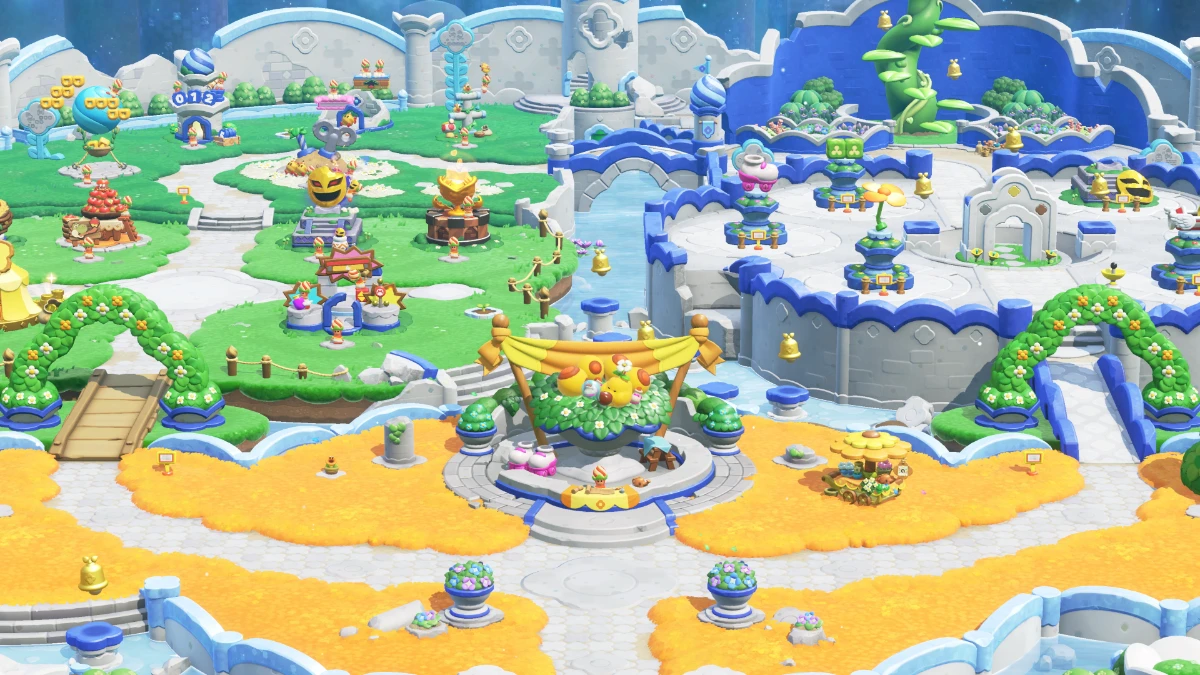
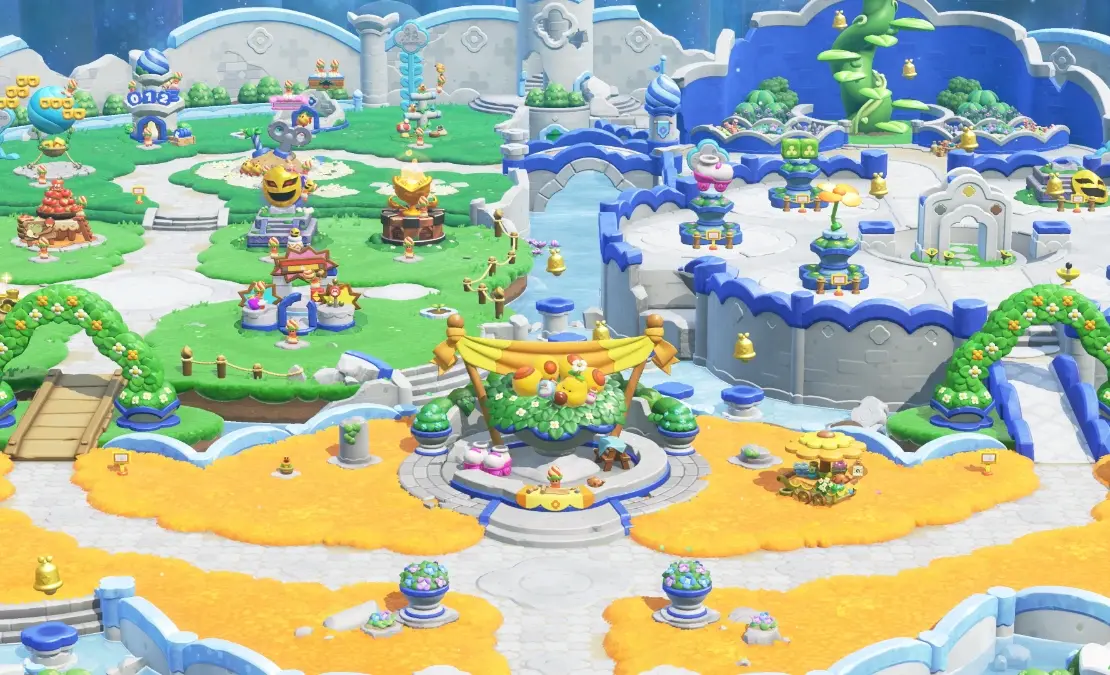
Bellabel Park unlocks after clearing just a handful of main story levels, which is a smart gate. Nintendo could have buried this behind 40 hours of campaign content. Instead, it sits adjacent to the core game, ready for whoever you invite over.
Solo players get access to plenty. The Toad Brigade Training Camp offers more than 70 bite-sized missions, and the new Koopaling boss battles can be tackled without a second controller. But the space clearly breathes best with others, and the cooperative attractions are where Nintendo’s design instincts shine brightest this generation.
Koopaling Boss Battles Set a New Bar
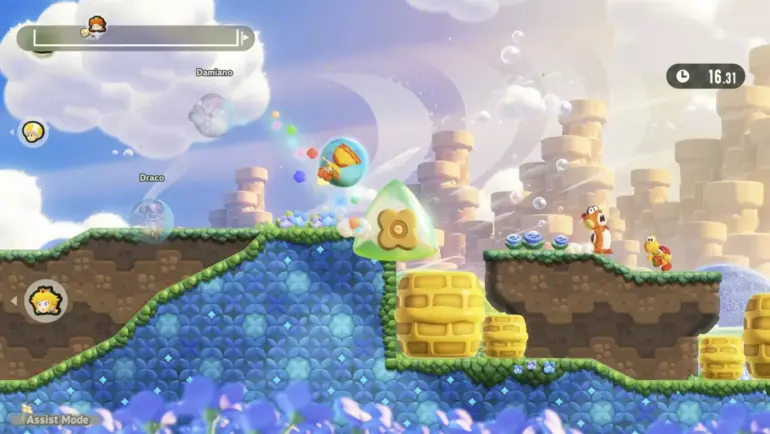
The boss fights in the original Wonder were its one consistent weak point. They leaned on the classic “jump on the head three times” format without much imagination, and the Wonder Effects that made every stage surprising didn’t carry into those confrontations. Nintendo heard those complaints.
Each of the seven Koopalings now carries Wonder Power granted by Bowser, and the results are genuinely creative encounters that push the platforming vocabulary in directions the base game never explored. Wendy transforms into an oversized Cheep Cheep and floods the arena with enemies through dimensional portals. Morton becomes a massive puppet controlled from the level’s background layer, forcing you to think in three planes of depth at once.
These fights are the best lineup of bosses in any 2D Mario entry. That’s not as high a bar as it sounds given the genre’s history of underwhelming sub-bosses, but reaching it still represents a meaningful step forward. Badge selection actually matters here for the first time. Equipping the Crouching High Jump to reach Morton’s ropes faster isn’t a gimmick; it’s a tactical choice that changes how the fight flows. Tougher remixed versions of each Koopaling become available later, and several of them pushed multiple retries. In a 2D Mario game, that’s almost unheard of.
Toad Brigade Training Camp: Wonder’s Endgame Finally Arrives
The Training Camp is where Wonder’s controls get properly stress-tested. More than 70 challenge courses ask you to do everything from clearing stages without touching a single enemy to racing a shell across lava platforms spaced just far enough apart that one mistimed jump ends the run.
The early missions stay relatively accessible. The final third escalates into something appreciably harder than anything in the base campaign. That difficulty spike feels earned rather than artificial, because Wonder’s input responsiveness is precise enough to support it. The controls don’t become a liability when the margin for error shrinks.
A genuinely new powerup, Flower Mario, debuts here. The transformation adds a Yoshi-style flutter jump and a projectile that fires straight up, letting you clear enemies from below rather than having to approach horizontally. Several missions build their design specifically around this ability, and it fits naturally alongside the existing toolkit. The way Mario skips along while transformed is, for what it’s worth, extremely cute.
The Dual Badge system introduces combinations of two badge abilities, and a handful of missions put them to creative use: one required playing simultaneously invisible and unable to stop jumping while avoiding enemies. The problem is that only a small portion of the catalog explores these combinations. Dual Badges suggest an enormous design space, and the Training Camp only samples the edge of it. A hundred more missions built around these combinations would have been time well spent.
We Played Bellabel Park with Nintendo
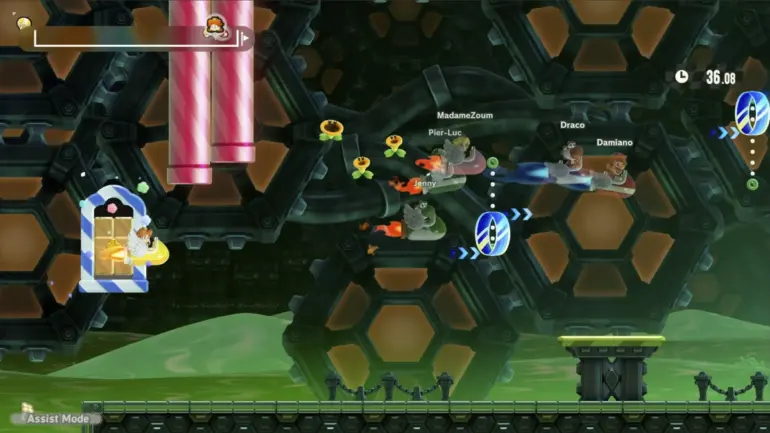
During Nintendo’s Switch 2 review week, we joined a eight-player Nintendo-hosted session in Bellabel Park’s cooperative attraction lineup. We also received the Turtle Beach Mario & Luigi Rematch Wireless Controller for Nintendo Switch 2 just in time for the launch, and it made an already fun session feel appropriately festive (full review coming soon). The setup put us through several of the local co-op games back-to-back, and the contrast between the stronger and weaker attractions became immediately clear.
Jump Count stood out as the cleverest design in the building. Your group is assigned a collective jump target for a given stage, but each player’s running tally stays hidden from everyone else. Coordination requires communication without real-time information. Guessing too high wastes the buffer, guessing too low blows past the goal. At the end of our run, the four of us tallied quietly, made a few corrective jumps, then watched the results as if waiting for a lottery draw. It’s a simple concept that generates surprising tension.
Fly Free, Captain Toad is the standout of the entire expansion. Captain Toad can’t jump, so he holds Plucky the bird above his head to jump for him. In co-op, one player controls Toad’s horizontal movement while the other manages the jump and flutter timing. Standard platforming stages become communication exercises. One player has directional authority; the other has vertical authority. Misalignment causes instant failure, and that friction generates exactly the kind of collaborative energy that distinguishes genuinely good local multiplayer from padded party content.

Donut Block Maker, where some players create temporary platforms for teammates to traverse, produced the session’s funniest moments, including a last-second save that required three people yelling the same instruction simultaneously.
The Competitive Side Disappoints
Not everything lands. The competitive minigames, both local and online, feel significantly thinner than the cooperative content.
Local competitive modes fit the Mario Party template: collect the most coins, feed your Baby Yoshi the most fruit, survive the longest. Phanto Tag comes closest to doing something interesting; players disguise themselves as environmental objects while seekers use clues to identify the impostors. The strategic layer is genuinely enjoyable for a round or two. The rest of the local competitive lineup runs out of ideas quickly.
Online multiplayer is more limited still. Most of it consists of vehicle races against ghost data from other players, which strips away the interaction that makes these modes worth playing. You can’t interact with the ghosts, so it effectively plays as a time trial with decoration. Online access is restricted to friend groups only, with one player per console. The juice doesn’t justify the squeeze.


Nothing in the competitive lineup is broken or unpleasant. It’s just shallow relative to the cooperative content, and shallow stands out more here because the co-op games demonstrate how inventive Nintendo can be when they prioritize it.
The Multiplayer Upgrades to the Base Campaign Matter
Two quality-of-life changes to the main campaign are worth knowing about before you buy, because they fix friction that could make Wonder frustrating for mixed-experience groups.
The first is a zoom-out option in local multiplayer. Wonder’s levels are carefully constructed teaching tools; each block placement and coin trail is intentional guidance. Four players on screen at once scrambles that readability. The wider camera view restores enough breathing room for beginners to track the environment and for experienced players to actually see what they’re doing.
The second is camera authority control. In the original version, the camera would shift focus based on factors like who died most recently or who reached the highest point on the flagpole. The result was that a less-experienced player could inadvertently dictate the pace for the entire group on harder stages. The Switch 2 edition lets you lock the camera to Player One, which is the natural choice for families and groups with significant skill gaps. Off-screen players now warp instantly back to Player One rather than waiting to be revived. These two changes aren’t dramatic features, but they address real problems that could stop a family from finishing a level together.
Visual and Performance Improvements
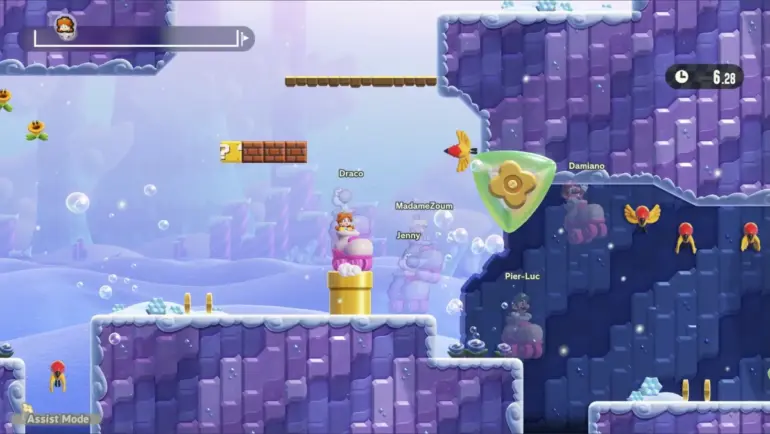
Wonder already looked remarkable. The Switch 2 version improves on it without redefining it, which is exactly what a platform upgrade should do.
Frame rate holds at a locked 60fps in sections that dropped on Switch 1, including an underwater encounter against Bowser Jr. that previously showed visible stutter. Docked play at 4K gives the Flower Kingdom’s color palette more room to breathe. Mario’s expressions register more clearly at higher resolution. None of this changes the fundamentals, but it makes an already expressive art style feel slightly more alive.
Rosalina joins the playable character roster, a few Pikmin references appear in the environment for those inclined to hunt them, and the Talking Flower has a new voice actor consistent with its other Switch 2 appearances. Players who prefer the original voice can boot the Switch 1 version from the main menu and still connect online with friends who haven’t upgraded. That backward compatibility handling is genuinely thoughtful.
Save data transfers instantly from the Switch 1 version, requiring no additional setup. Given how poorly some other Nintendo Switch 2 Edition upgrades have handled the transition between old and new content, this is worth noting explicitly.
Verdict
Super Mario Bros. Wonder’s Switch 2 Edition sets a reasonable template for what platform upgrade releases should look like. The Koopaling boss battles are the best the series has produced in 2D. The Toad Brigade Training Camp delivers the difficult, precision-focused endgame that Wonder’s controls always deserved. The cooperative multiplayer modes, particularly Fly Free, Captain Toad and Jump Count, find genuinely creative applications for the platforming mechanics that the base game never explored.
The competitive lineup fails to reach that standard, and the Dual Badge system leaves significantly more design potential untapped than it uses. But the cooperative content, the campaign improvements, and the performance upgrades collectively justify the entry price, whether you’re upgrading from Switch 1 or playing Wonder for the first time.