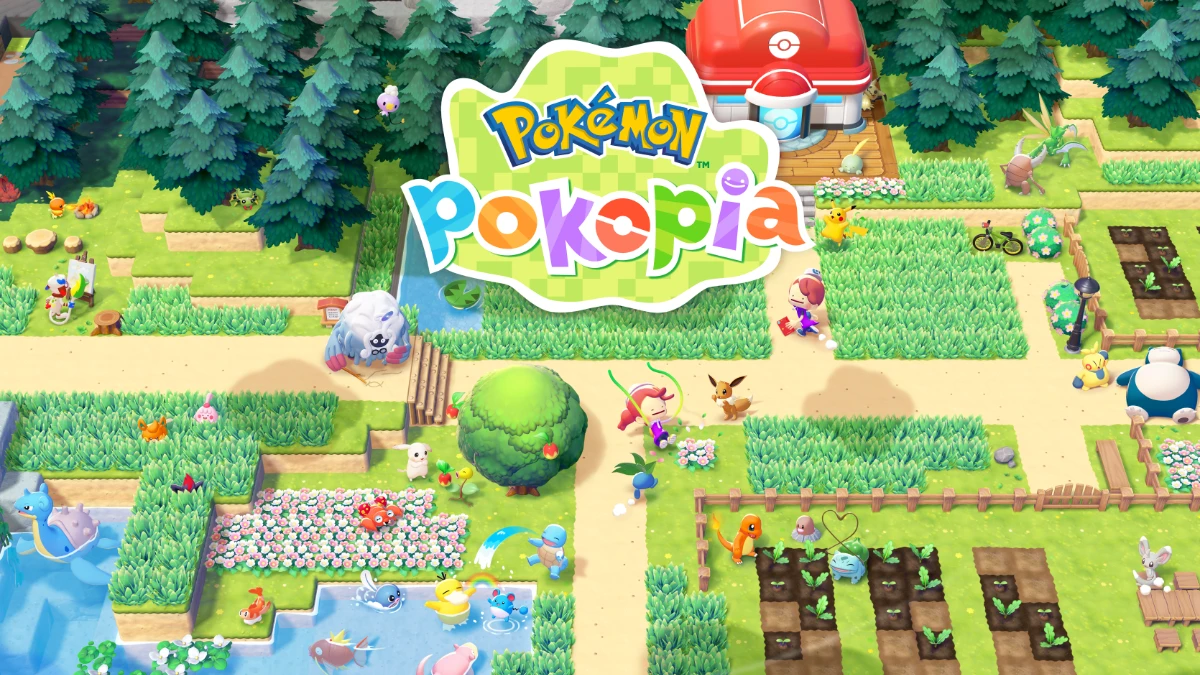

Pokémon Pokopia doesn’t reinvent what a Pokémon game can be so much as it quietly dismantles the assumption that those two words must always mean the same thing. Set in a post-collapse Kanto where every human has vanished and the Pokémon are left to fend for themselves, Pokopia asks a simple, quietly devastating question: what if you had to take care of them for once? You play as a Ditto disguised as a trainer, and that role reversal carries more weight than it might first appear. This is a cozy sandbox built on genuine warmth, one that folds survival, discovery, and community into something that happens to be the most emotionally resonant Pokémon game in the franchise’s 30-year history.
A World That Hurts by Design
Kanto without humans is not the idyllic retreat the premise might imply. The habitats are crumbling. Pokémon that once relied on trainers for food, shelter, and guidance can’t always manage without them. Professor Tangrowth serves as your quiet anchor in all of this, pointing you toward the next broken corner of the world and letting you piece together what it needs. The guidance is light, but purposeful.
What makes the world work is not its visual palette or its sandbox scope, though both are well-realized on Switch 2. It’s the specific texture of individual Pokémon stories. An Onix trapped inside a collapsed rock cave. A Squirtle too dehydrated to use Water Gun. A Slowpoke who, with your help, learns to make it rain. These are not grand narrative moments. They are small, precisely constructed emotional beats, and they accumulate into something that feels genuinely moving rather than manipulative. You care because the game builds systems around caring.
The art direction leans warm and slightly muted, consistent with the idea that this world is recovering rather than thriving. Pokémon look more expressive than they have in any prior entry, which matters here more than it would in a mainline game. A Pikachu’s concern reads clearly. Tinkaton’s enthusiasm is immediately legible. These small visual choices do real narrative work.
The Ditto at the Center
Playing as a Ditto who has assumed a trainer’s appearance is a more interesting protagonist conceit than the series has offered before. You are both familiar and hollow: the shape of a trainer without the history or authority one carries. The Pokémon around you don’t fully trust you at first, and a few seem quietly suspicious of what you are. That friction is subtle, resolved not through cutscenes but through the act of helping.
Professor Tangrowth fills the mentor role without being overbearing. The game wisely keeps the narrative stakes low. There is no villain, no countdown, no world-ending threat. The antagonistic force in Pokopia is entropy itself: the slow decay of a world that lost its caretakers. That framing gives every task you complete a quiet moral weight without reaching for melodrama.
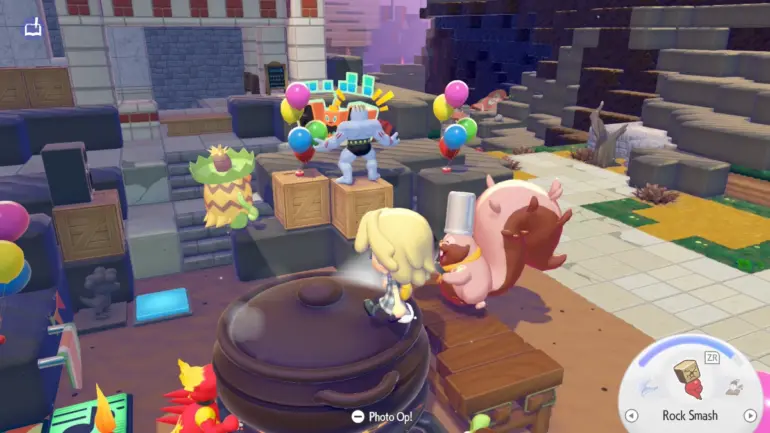
The emotional arc builds through accumulation. Unlock a new Habitat Dex entry. Watch a Pokémon move into a space you built for them. Get roped into a selfie by a very enthusiastic Charmeleon. These moments don’t land because the writing demands it; they land because you did the work that made them possible.
Building, Harvesting, and the Central Loop
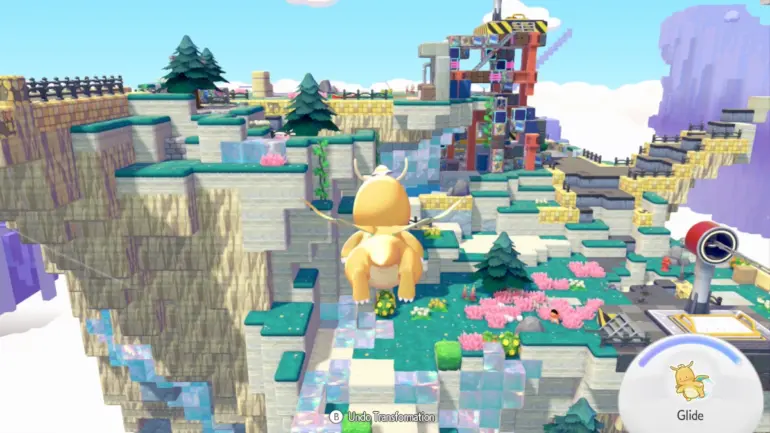
Pokopia’s core loop borrows structural DNA from Dragon Quest Builders and Minecraft: gather materials, construct habitats, attract Pokémon, unlock new capabilities. What keeps it distinct is how resource acquisition is tied to Pokémon encounters. You learn attacks from the Pokémon you help, and those attacks become your toolkit for reshaping the environment. Water Gun from Squirtle breaks through dry terrain. A move learned from Geodude clears rubble. Switching between them in real time, without entering a menu, keeps momentum intact in a way that most cozy games fail to sustain.
The Team Initiation Challenges layer structured goals onto this open loop. Build a specific habitat. Deliver items to the tower in the Withered Wastelands. These function as pacing anchors that guide exploration without forcing it. The challenge design scales naturally with the player’s progression through the Habitat Dex, so the game rarely asks for something you don’t yet have the capability to produce.
Compared to Animal Crossing: New Horizons, the most obvious genre reference point, Pokopia moves faster and demands more active engagement. Building a shelter takes hours rather than real-world days. Items at the Pokémon Center are available immediately. Delayed gratification is not the hook here; the hook is discovery and the satisfaction of watching something you built become a home.
Habitats, Discovery, and What Lives Within Them
The Habitat Dex is Pokopia’s version of a Pokédex, and it’s a smart structural choice. Rather than cataloguing creatures you’ve caught, it catalogues worlds you’ve created. Each habitat type attracts different Pokémon, and figuring out which materials and attacks combine to produce a new habitat carries a low-friction puzzle quality that rewards curiosity.


The discovery moment, when a Pokémon appears in a newly completed habitat and you get to talk to them, works because the game refuses to rush it. The animation is unhurried. The Pokémon has something specific to say. Photo mode, which might have been a throwaway feature, earns its place: Pokémon actively participate in selfies with genuine enthusiasm, and that interactivity makes it worth using repeatedly rather than once for the novelty.
The roster includes Kanto starters, Tinkaton (making its first meaningful appearance in a Kanto-set game), Rotom, and a selection of others that covers a range of emotional registers without feeling like a checklist. Each Pokémon’s initial task is tailored to their design and disposition in ways that demonstrate care in the writing process.
Themes Worth Sitting With
Pokopia is quieter than it looks about what it’s actually exploring. A post-collapse world where the only path forward is building community infrastructure together is not a subtle metaphor, but the game earns its messaging by making you feel the weight of collective effort rather than just asserting it. Working with Slowpoke to make it rain so Onix can escape is a two-Pokémon solution to a problem neither could solve alone. That design logic runs through most of the game’s task structure.
The franchise has rarely engaged with civic ethics. Pokopia does, and it does so through systems rather than cutscenes, which is the correct instinct. The result is a Pokémon game that, within its cozy constraints, says something genuine about interdependence and the work of repair.
Performance and Presentation
Pokopia runs cleanly on Switch 2. No frame pacing issues were observed, load times are brief, and the game’s visual warmth translates well to both docked and handheld modes. Controls are responsive and intuitive, with attack-swapping and habitat-building mapped in ways that become automatic quickly. The Switch 2 library is, at this point, performing with enough consistency that strong technical execution feels like the baseline rather than a differentiator. Pokopia clears that bar without requiring comment.
Verdict
Pokémon Pokopia is the home console Pokémon experience the franchise has been building toward without fully committing to until now. Its post-collapse Kanto is small by open-world standards but dense with specific emotion, and its central loop of habitat creation, resource gathering, and Pokémon discovery sustains genuine engagement across its runtime.
The narrative stays deliberately low-stakes and is better for it: entropy and isolation are more affecting antagonists here than any human villain could have been. While players seeking mainline RPG structure or competitive depth will find those systems absent, Pokopia is not trying to replace them. It is doing something the series has rarely attempted: building a Pokémon game about taking care instead of capturing, about community instead of competition. It lands that premise with conviction.