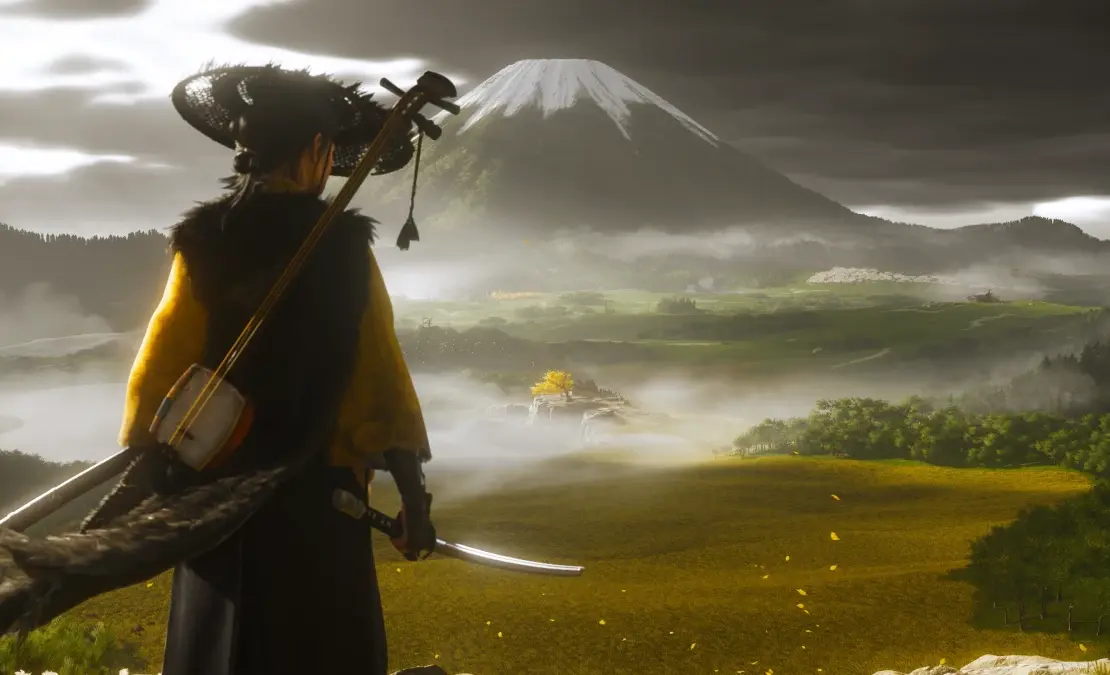

Ghost of Yotei takes what worked in Tsushima and sharpens it into something leaner and more brutal. Sucker Punch built this sequel around a revenge-driven protagonist, Atsu, who trades honor for survival and turns the series’ combat into a rhythm of precise weapon swaps and relentless aggression. The shift from Jin’s conflicted samurai to Atsu’s unapologetic fury gives Yotei a more human edge.
It still follows familiar open-world beats, but the lawless Ezo region, the trauma-fueled narrative arc, and combat that rewards mastery over button mashing make this iteration feel more focused than its predecessor. The game rarely reinvents the wheel. It doesn’t need to. What it does is refine Tsushima’s foundation into a tighter, more confident experience that understands what made the original compelling and doubles down on those strengths.
A Revenge Arc Rooted in Trauma
Atsu’s story begins with violence. The Yotei Six, a group of rogue samurai turned regional warlords, murdered her family when she was a child. Years later, she tracks them down one by one across Ezo, starting with a swift execution of The Snake that sets the tone for everything that follows. This is not a tale of redemption or honor. Atsu wants blood, and the game does not shy away from the psychological weight of that pursuit.
The narrative uses flashback sequences sparingly but effectively. Each encounter with a member of the Yotei Six triggers fragmented memories of the night Atsu lost everything. These moments are brief, visceral, and never melodramatic. They serve to remind you why Atsu fights, without turning her into a one-note character. She is driven, yes, but the game gives her room to express doubt, exhaustion, and even moments of dark humor through interactions with companions and NPCs scattered across Ezo.
The Yotei Six themselves are more than quest markers. Each has carved out a pocket of Ezo through force, and their backstories reveal how ambition, desperation, and cruelty shaped them into the figures they are now. Lord Saito, their leader, looms large as the final target, but the journey to him involves unraveling the individual stories of his lieutenants. Some are ideologues. Others are opportunists. A few are simply broken people who chose violence as a coping mechanism. The game does not excuse their actions, but it does contextualize them in ways that make their eventual defeats feel earned rather than hollow.
Atsu’s companions add texture to the revenge motif without overwhelming the core arc. Oyuki, a strategist with a pragmatic worldview, offers counterpoints to Atsu’s single-minded pursuit. Their conversations feel natural, grounded in the harsh realities of Ezo rather than forced emotional beats. The game trusts you to pick up on subtext without spelling everything out, and that restraint makes the quieter moments between setpieces more impactful.

Ezo: Beauty and Brutality in Equal Measure
Ezo in the early 1600s is a frontier region, and Sucker Punch captures that lawlessness through environmental storytelling. Burned-out villages, roaming bandit patrols, and bounty hunters tracking your movements create a world that feels hostile without relying on constant enemy encounters. The region is less geographically diverse than Tsushima, but what it lacks in biome variety it makes up for in atmosphere. Vast grasslands ripple under guiding winds, wildflowers punctuate the green expanse, and snow-capped mountains frame the horizon. The color palette shifts subtly between regions, from warm golds in the lowlands to cold blues in the highlands, and the transitions feel organic rather than segmented.
Sucker Punch learned from Tsushima’s fox chases and scaled back the repetitive collectible loops. What remains are more purposeful activities tied to exploration and progression. Birds still signal points of interest, but the variety is wider: wolf dens, bamboo cutting challenges, hot springs for health upgrades, and environmental puzzles gated behind observation and timing.
The puzzle design is hit or miss. Some require you to follow environmental cues (symbols etched into stone, wind direction, light refractions), while others lean too heavily on trial and error. The game reuses a few puzzle types more than necessary, particularly in the mid-campaign bottlenecks that separate Ezo’s zones. These moments slow pacing when momentum matters most, but they are brief enough that they don’t derail the experience.
The open-world structure allows for detours, and the game rewards curiosity. Side quests often lead to duels with named opponents, ambush scenarios that test your weapon-swapping instincts, or cultural vignettes that nod to the indigenous Ainu people of the region. Sucker Punch handles these inclusions with respect, framing them as part of Ezo’s identity without reducing them to set dressing. The writing here is factual and grounded, avoiding both romanticization and appropriation.
Combat: A Dance of Weapons and Timing
Combat is where Ghost of Yotei justifies its existence. Atsu carries multiple weapon types (katana, kusarigama, dual blades, spear, odachi), each with distinct weight, reach, and utility. Enemies are designed around weapon counters, creating a rock-paper-scissors dynamic that forces adaptation rather than spam. Heavy armored foes absorb katana strikes but crumble under odachi swings. Shielded units require the kusarigama’s chain to yank shields away. Fast attackers get punished by the spear’s reach and crowd-control potential. Dual blades shred stagger meters but leave you vulnerable during recovery frames. Weapon switching is instantaneous, mapped to the D-pad, and the flow of combat depends on reading enemy compositions and responding in real time.
The kusarigama is the standout addition. Beyond shield breaking, it functions as a mid-range assassination tool, letting you yank isolated enemies toward you for silent kills. In open combat, its sweeping arcs control space and interrupt enemy formations. It feels distinct from anything in Tsushima, and mastering its timing windows separates competent players from those who truly internalize the combat loop.
Parrying and dodging anchor the defensive side of combat. Blue glints telegraph parry windows, and landing them opens enemies to devastating counterattacks. Perfect parries trigger one-hit kills against standard foes, while tougher enemies require follow-up chains. Dodging is directional and tight, rewarding anticipation over panic rolling. The game punishes overreliance on either mechanic. If you parry too early, you eat the full hit. If you dodge into the wrong space, you walk into secondary attacks or environmental hazards.
Disarm mechanics raise the stakes. Certain heavy attacks knock weapons from your hands, forcing you to scramble and recover them while enemies press the advantage. These moments are chaotic, stressful, and deeply satisfying to escape. The game communicates danger clearly, giving you tools to avoid disarmament (blocking, perfect parries, positional awareness), but if you ignore the tells, you pay for it.

Stealth remains viable but feels less emphasized than in Tsushima. Tall grass, rooftop vantage points, and tight alleyways give you the tools for silent kills, and smoke bombs bail you out when things go loud. The game never forces stealth, and most encounters allow you to choose your approach.
If stealth fails, combat begins immediately without punishment beyond losing the element of surprise. Given how satisfying the weapon systems are, going loud often feels like the intended experience. The standoff mechanic returns, letting you challenge one to three enemies in timed draws before a fight. Landing these kills reduces enemy numbers and builds momentum. Missing them costs health but doesn’t auto-fail the encounter. It is a risk-reward loop that fits Atsu’s aggressive personality.

Progression: Mastery Over Grind
Ghost of Yotei abandons traditional XP systems. Progress ties to shrine discovery, environmental challenges, and quest completion. Unlocking new skills requires finding specific shrines scattered across Ezo, many of which are tucked behind platforming sequences or light puzzle gates. This approach makes exploration feel meaningful. Every shrine you discover expands Atsu’s toolkit, whether through new combat techniques, tool upgrades, or passive perks tied to charms.


Charms function as build modifiers. Some boost parry windows. Others increase damage output for specific weapon types or reduce tool cooldowns. Armor sets reinforce playstyle choices, offering perks that emphasize stealth, aggression, or survivability. One standout set disables standard parries in exchange for widening perfect parry timing and boosting counter damage. It is a high-risk option that forces precision but rewards mastery. The game does not lock powerful techniques behind mandatory story beats. If you explore, you find them early. If you rush the main path, you miss them. That friction between optional content and core progression is intentional. Sucker Punch wants you to poke around, and the combat benefits from the expanded moveset.
Boss Fights: High-Stakes Duels and Stagger Management
Duels against the Yotei Six and other named opponents function as skill checks. These fights strip away the chaos of multi-enemy brawls and force you to focus on parry timing, dodge precision, and stagger management. Enemies have health bars and stagger meters. Stagger fills through blocked attacks, perfect parries, and sustained pressure. Once broken, a critical window opens for massive damage. The rhythm is deliberate. You cannot button mash your way through. Each boss telegraphs attacks with visual and audio cues, and learning their patterns is essential. Some duels take dozens of retries. The difficulty is calibrated for mastery, and the satisfaction of finally landing the killing blow after hours of attempts is immense.
One late-game superboss stands apart as an optional nightmare. The fight demands near-perfect execution, combining dodge timings, parry chains, and weapon swaps into a single fluid sequence. It took well over an hour and countless retries to defeat, and the victory felt like a genuine achievement rather than a participation trophy.
Presentation: Visual and Auditory Craftsmanship
Ghost of Yotei is a technical showcase. The grasslands react to wind physics in real time, pollen scatters across the air, and weather transitions seamlessly between clear skies and stormy downpours. The guiding wind mechanic returns as both a navigation tool and a visual flourish. Swiping up on the touchpad summons a gust that points toward active objectives, but watching that wind ripple through fields of wildflowers or kick up snow on mountain peaks never stops being striking.
Erika Ishii’s performance as Atsu anchors the audio design. Her delivery captures exhaustion, rage, and dry humor without ever tipping into overacting. The supporting cast matches that restraint, grounding conversations in the harsh realities of Ezo’s lawless territories. Sword clashes carry weight, armor clinks with every dodge roll, and environmental audio (rushing water, wind through trees, distant wildlife) layers depth into every biome. The shamisen returns as both a gameplay tool and a thematic thread. Playing songs at specific locations reveals nearby collectibles, hot springs, or hidden paths. It is a diegetic guidance system that reinforces the game’s commitment to minimizing HUD clutter.
Kurosawa Mode returns, converting the game into black-and-white with film grain and adjusted audio for a classic samurai cinema aesthetic. New modes include a hyper-violence filter that cranks blood splatter and a lo-fi beats overlay that leans into Samurai Champloo vibes. These are cosmetic flourishes, but they demonstrate Sucker Punch’s awareness of its cinematic influences and willingness to let players customize presentation to match their mood.

What Holds It Back
The puzzle overuse mentioned earlier is the main friction point. Certain symbol-matching sequences and timed platforming gates appear too frequently in story missions, breaking combat flow when you want momentum. A few late-game encounters also lean on enemy spam rather than interesting compositions, turning what should be climactic fights into endurance tests. These moments are rare, but they stick out against the otherwise tight pacing.
The narrative occasionally leans on convenient escapes during cutscenes. You corner a Yotei Six member, and they vanish before you can land the killing blow. It happens multiple times, and while the game uses these moments to build tension, they can feel repetitive when the pattern becomes predictable.
Verdict
Ghost of Yotei refines Tsushima’s samurai fantasy into something sharper and more focused. Atsu’s revenge-driven arc sidesteps the honor conflict that defined Jin, giving the game a more human, visceral edge. The combat is the best in the series, with weapon-swapping mechanics and parry-heavy duels that reward mastery over button mashing. Ezo is less geographically varied than Tsushima, but it compensates with atmosphere, environmental storytelling, and a frontier lawlessness that permeates every encounter.
The puzzle overuse and occasional narrative convenience hold it back slightly, but these are minor friction points in an otherwise exceptional package. Sucker Punch built a sequel that understands what worked and pushed those elements further. If you liked Tsushima, Yotei improves on almost every front. If you bounced off the first game’s pacing, this tighter, more aggressive iteration might win you over. Either way, it is one of the strongest action games in recent memory.