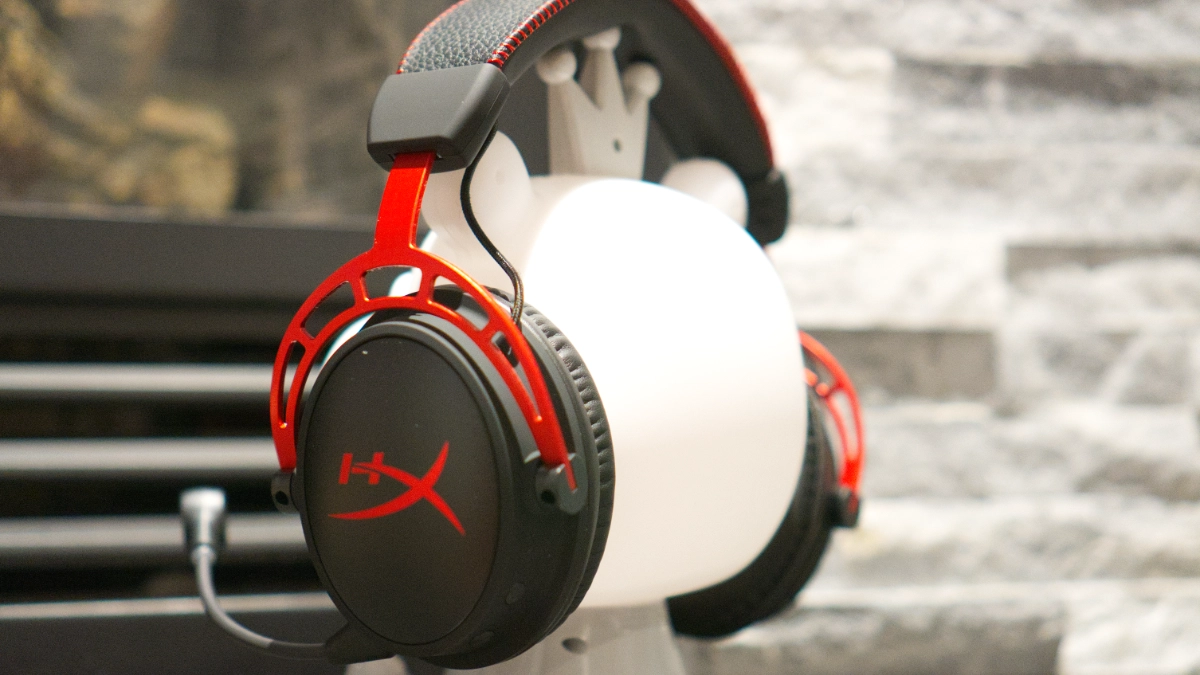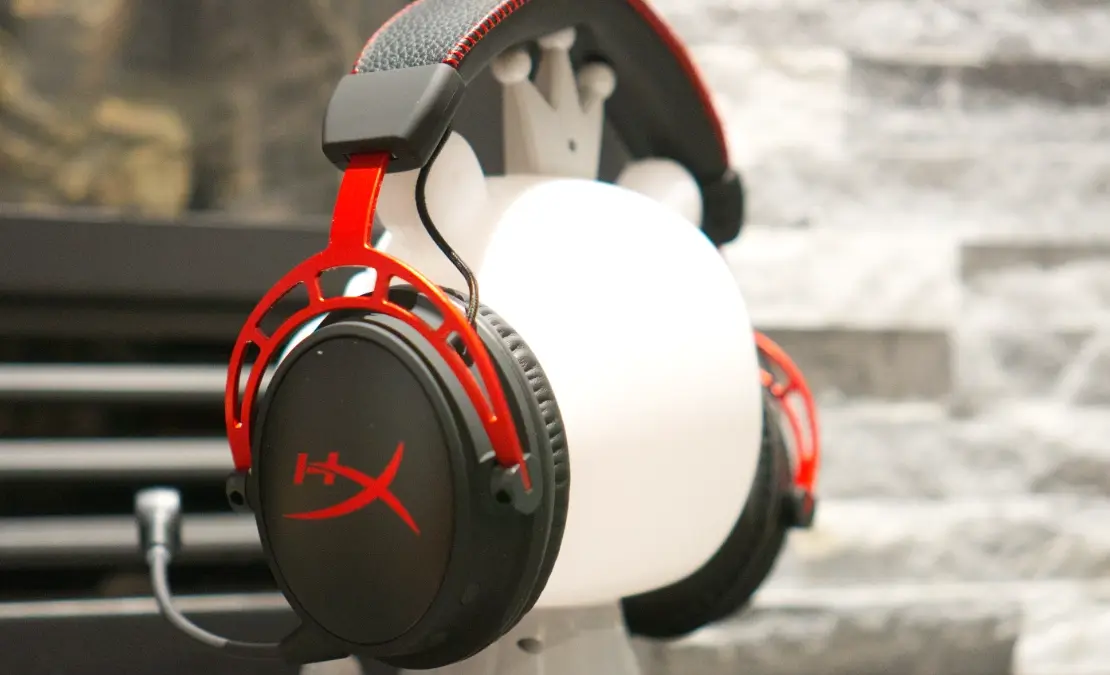

The HyperX Cloud Alpha Wireless (starting at $199.99, often found around $179) takes the beloved Cloud Alpha formula and cuts the cord without gutting the battery. HyperX advertises up to 300 hours of wireless runtime, and our testing clocked in at a remarkable 327 hours and 27 minutes. That number alone earns a double-take. The headset pairs that stamina with the same comfortable memory foam ear cushions, leatherette build, and generally flattering gaming sound that made the wired Cloud Alpha a fan favorite.
The trade-offs are real, though. Connection runs exclusively through a 2.4GHz USB-A dongle, with no Bluetooth and no wired 3.5mm fallback for listening. Xbox users get no support at all. The SteelSeries Arctis 7+ competes at a similar price with broader platform coverage, and the Razer Barracuda X undercuts both on price with respectable wireless performance. For pure battery endurance, nothing in this category touches the Cloud Alpha Wireless. For versatility, you may want to look elsewhere.
Editor’s Take
The HyperX Cloud Alpha Wireless delivers a genuinely jaw-dropping battery life and comfortable all-day fit, but its 2.4GHz-only connection and lack of Xbox support limit who should buy it.
Pros
- Extraordinary 300-plus-hour battery life
- Comfortable memory foam and leatherette cushions
- Solid, sturdy build quality
- Good gaming sound with satisfying low-end weight
- Works well on PC and PlayStation
Cons
- No Bluetooth connectivity
- No wired 3.5mm fallback listening mode
- Zero Xbox support
- HyperX NGenuity software feels inconsistent
- Microphone clarity trails top-tier competitors
At a Glance
| Spec | Details |
|---|---|
| Driver Size | 50mm dynamic |
| ANC | None |
| Battery Life | 327 hr 27 min (tested) |
| Connectivity | 2.4GHz USB-A dongle only |
| Codec Support | Proprietary 2.4GHz wireless |
| Platform Support | PC, PlayStation, Nintendo Switch (docked) |
| Weight | 327g |
| Price | $199.99 USD (often ~$179 USD street) |
| Verdict | Unbeatable battery life for PC and PlayStation gamers who never need to leave the couch. |
Configurations: One Sku, One Shot
HyperX keeps the Cloud Alpha Wireless simple. There is one version. You get one color option (black with red accents), one connection method (the 2.4GHz USB-A wireless dongle), and one price point.
At launch, HyperX set the retail price at $199.99 USD. Street pricing has since drifted toward $179 USD at most major retailers. Canadian buyers can typically find the Cloud Alpha Wireless through Best Buy Canada, Amazon.ca, and Memory Express, where pricing tracks closely with the USD equivalent after exchange.
No higher-tier configuration exists. No upgraded cable bundle. No carrying case variant. What you see is what you get, which makes the purchasing decision refreshingly uncomplicated. The only real question is whether the feature set matches your setup.
Design: Cloud DNA in a Wireless Body
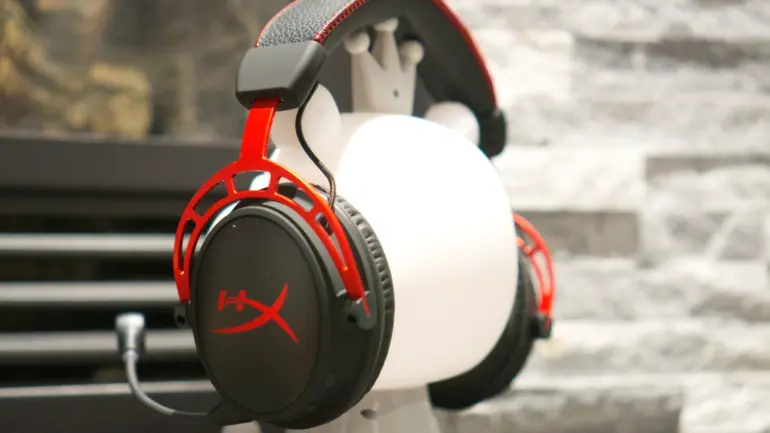
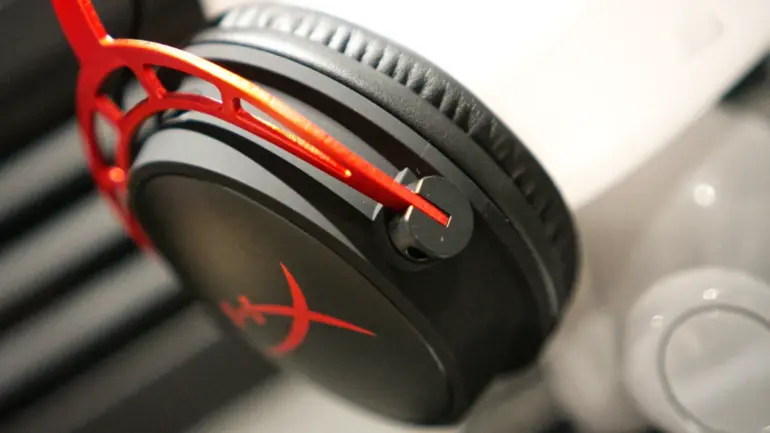
HyperX keeps the Cloud Alpha Wireless visually consistent with the broader Cloud family. The black-and-red color scheme is assertive without screaming at you from across the room. The headband arc and angular ear cups read as gaming hardware, though the proportions stay tasteful enough for general use.
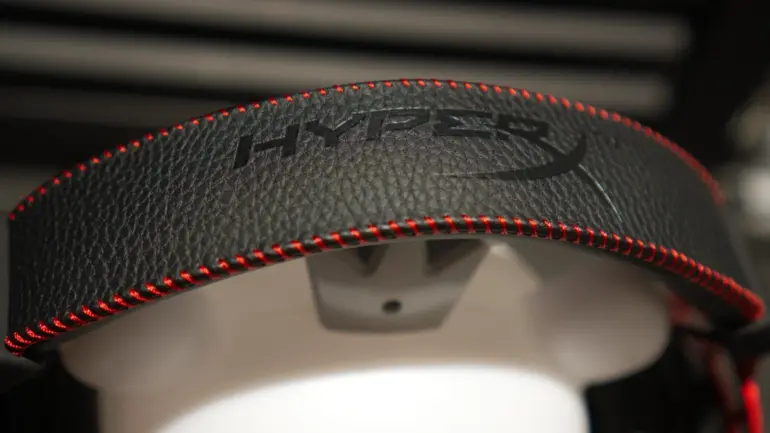
The headset measures in at 327g, a weight that most wearers report as manageable during extended sessions. The headband padding and dual-chamber ear cups feature memory foam wrapped in leatherette, a combination that holds up well during long gaming nights. The frame feels sturdy under flex testing, with no alarming creaking or chassis give.
Connectivity lives entirely on the 2.4GHz USB-A dongle that ships in the box. There is no Bluetooth radio, no USB-C wired option, and no 3.5mm fallback mode for passive listening when the battery eventually does die. If the dongle walks off or you forget it at home, the headset becomes a paperweight. HyperX places the USB-A receiver on a short USB-C to USB-A adapter, which adds minor flexibility for devices with USB-C ports, but the wireless-only architecture remains a firm constraint.
Platform support covers PC and PlayStation comfortably. Nintendo Switch in docked mode works through the dongle. Xbox, however, receives no support, a genuine dealbreaker for players in a mixed-console household.
On the controls side, you get a volume wheel, a mic mute button, and a power toggle. The layout is clean and easy to locate by feel. HyperX built in a retractable boom microphone that tucks away when you want it out of sight.
HyperX backs the Cloud Alpha Wireless with a two-year warranty.
Full Specifications
| Specification | Details |
|---|---|
| Driver Size | 50mm dynamic dual-chamber drivers |
| Frequency Response | 15Hz to 21,000Hz |
| Impedance | 62 ohms |
| Connectivity | 2.4GHz USB-A wireless dongle |
| Bluetooth | None |
| Wired Fallback | None |
| Codec Support | Proprietary 2.4GHz wireless |
| Platform Support | PC (Windows/Mac), PlayStation 4/5, Nintendo Switch (docked) |
| Xbox Support | None |
| Battery Life | 327 hr 27 min (tested); up to 300 hr (advertised) |
| Microphone | Detachable boom mic, noise-canceling, cardioid polar pattern |
| ANC | None |
| Ear Cup Style | Circumaural (over-ear) |
| Cushion Material | Memory foam, leatherette |
| Weight | 327g |
| Software | HyperX NGenuity (Windows, EQ and DTS Headphone:X spatial audio) |
| Charging | USB-C port (charging only) |
| Price | $199.99 USD launch; ~$179 USD street |
Sound, Comfort, and Features: Built for the Long Haul
Comfort Over Distance
Where the Cloud Alpha Wireless earns its stripes is in long-session wear. The memory foam ear pads conform without clamping aggressively, and the leatherette surface stays reasonably cool. Some wearers notice heat buildup during summer sessions, a limitation of sealed leatherette cups in general. The headband distributes weight evenly, and at 327g, the Cloud Alpha Wireless avoids the neck-strain territory that heavier flagship headsets can fall into.
The retractable boom mic sits naturally when extended and disappears cleanly into the left ear cup when not needed. Mute and volume controls respond with a satisfying click. Nothing about the physical experience disappoints.

Sound Tuning: Fun, Not Flat
HyperX voices the Cloud Alpha Wireless with a consumer-friendly frequency response. The low end receives a noticeable boost, which adds weight to explosions, footsteps, and cinematic scores. This approach flatters gaming content and keeps casual listening enjoyable, though audiophiles chasing flat reference tuning will want to reach for the EQ immediately.
Midrange clarity holds up well enough for dialogue and in-game communication. High-frequency extension is decent, if slightly rolled off compared to open-back alternatives. Spatial awareness in competitive shooters is adequate, and enabling DTS Headphone:X through the NGenuity software adds some directional width, though the effect depends on the game engine’s audio mix.
The sound signature does not compete with the absolute best in this price range for pure fidelity, but it stays honest and enjoyable across most gaming scenarios.
Microphone: Functional, Not Outstanding
The detachable boom mic handles Discord calls and party chat capably. Voices come through clearly enough for teammates to understand you without issue. Dynamic range and the noise-rejection performance trail what you get from a dedicated condenser mic or from competitors like the SteelSeries Arctis 7+, which offers crisper voice capture. If you stream, podcast alongside gaming, or need broadcast-quality pickup, the Cloud Alpha Wireless mic will frustrate you. For standard gaming chat, it suffices.
HyperX NGenuity Software: Capable but Inconsistent
HyperX NGenuity gives you EQ customization and access to DTS Headphone:X spatial audio. The interface is functional and the EQ bands allow meaningful tuning. The problem is reliability. NGenuity can behave inconsistently: settings occasionally fail to persist after a power cycle, and the application has earned a reputation for needing restarts. Compared to SteelSeries Sonar or Logitech G Hub, NGenuity feels less polished and less dependable as a daily-use companion. HyperX has pushed updates over the years that improve stability, but the software remains a weaker link in an otherwise solid package.

Battery Life: The Main Event
The headline claim HyperX makes for the Cloud Alpha Wireless is 300 hours of wireless battery life. Our testing returned 327 hours and 27 minutes. That number is not a typo.
To put it in perspective: the SteelSeries Arctis 7+ achieves roughly 30 hours per charge. The Razer Barracuda X lands around 50 hours. Most wireless gaming headsets in this price range require a weekly charge at best. The Cloud Alpha Wireless requires a charge roughly once every two weeks of heavy use, or once a month for lighter users. At maximum, you could theoretically go over 13 days of continuous audio before the battery gives out.
The practical consequence is that battery anxiety simply disappears. You will never reach for the headset before a late-night gaming session and find a dead battery. For players who treat charging as an afterthought, this headset removes an entire category of frustration.
Charging happens through a USB-C port on the headset. No wireless charging dock, no proprietary cable. A standard USB-C cable gets the job done. HyperX does not specify exact charge time from flat, but a full charge takes several hours given the battery capacity involved.
The only downside to the battery architecture is what it costs you in contingency options. Because there is no 3.5mm wired fallback, a dead battery means silence. With most competitors, plugging in a cable buys you indefinite wired use. Here, a drained headset is a non-functional headset until recharged.
How the HyperX Cloud Alpha Wireless Compares
| Feature | HyperX Cloud Alpha Wireless | SteelSeries Arctis 7+ | Razer Barracuda X | HyperX Cloud Alpha (Wired) |
|---|---|---|---|---|
| Driver Size | 50mm dual-chamber | 40mm | 40mm | 50mm dual-chamber |
| ANC | None | None | None | None |
| Battery Life | 327 hr (tested) | ~30 hr | ~50 hr | N/A (wired) |
| Connectivity | 2.4GHz USB-A dongle | 2.4GHz USB-A dongle | 2.4GHz USB-C dongle | 3.5mm wired |
| Bluetooth | No | No | Yes | No |
| Wired Fallback | No | Yes (3.5mm) | Yes (3.5mm) | Yes (native) |
| Platform Support | PC, PS4/5, Switch (docked) | PC, PS4/5, Switch | PC, PS4/5, Switch, mobile | PC, PS4/5, Switch, Xbox, mobile |
| Xbox Support | No | No | No | Yes |
| Weight | 327g | 354g | 250g | 298g |
| Price (street) | ~$179 USD | ~$149 USD | ~$99 USD | ~$99 USD |
| Best For | Maximum battery, PC/PS5 | Balanced wireless with wired backup | Budget wireless + Bluetooth + mobile | Versatile budget wired gaming |
Frequently Asked Questions
How long does the HyperX Cloud Alpha Wireless battery actually last?
HyperX advertises up to 300 hours. Our testing measured 327 hours and 27 minutes under standard conditions. That easily outpaces every major competitor in the gaming headset category by a factor of five or more.
Does the HyperX Cloud Alpha Wireless work on Xbox?
No. The Cloud Alpha Wireless uses a 2.4GHz USB-A dongle that lacks Xbox compatibility. Xbox players should consider the wired HyperX Cloud Alpha or a headset with Microsoft’s Xbox Wireless protocol built in.
When will the HyperX Cloud Alpha Wireless be available in Canada, and where can I buy it?
The headset is currently available in Canada through Best Buy Canada, Amazon.ca, and Memory Express. Pricing tracks closely with the USD street price after conversion, typically landing in the $220 to $250 CAD range depending on the retailer and current promotions.
Does the HyperX Cloud Alpha Wireless support Bluetooth?
No. The headset connects exclusively via the included 2.4GHz USB-A dongle. There is no Bluetooth mode, which means you cannot pair it with a phone, tablet, or laptop without a USB-A port. If Bluetooth is a priority, the Razer Barracuda X adds that feature at a significantly lower price.
Can you use the HyperX Cloud Alpha Wireless with a wired cable when the battery dies?
No. The Cloud Alpha Wireless has no 3.5mm wired fallback mode. When the battery drains, the headset stops working until recharged. Competitors like the SteelSeries Arctis 7+ retain passive wired functionality through a 3.5mm connection.
Is the HyperX Cloud Alpha Wireless worth it over the SteelSeries Arctis 7+?
It depends on your priorities. The Cloud Alpha Wireless wins decisively on battery life and offers comparable comfort. The Arctis 7+ costs less at street price, includes a 3.5mm wired fallback, and benefits from the more polished SteelSeries Sonar software suite. If you forget to charge things and primarily play on PC or PlayStation, the Cloud Alpha Wireless earns its premium.