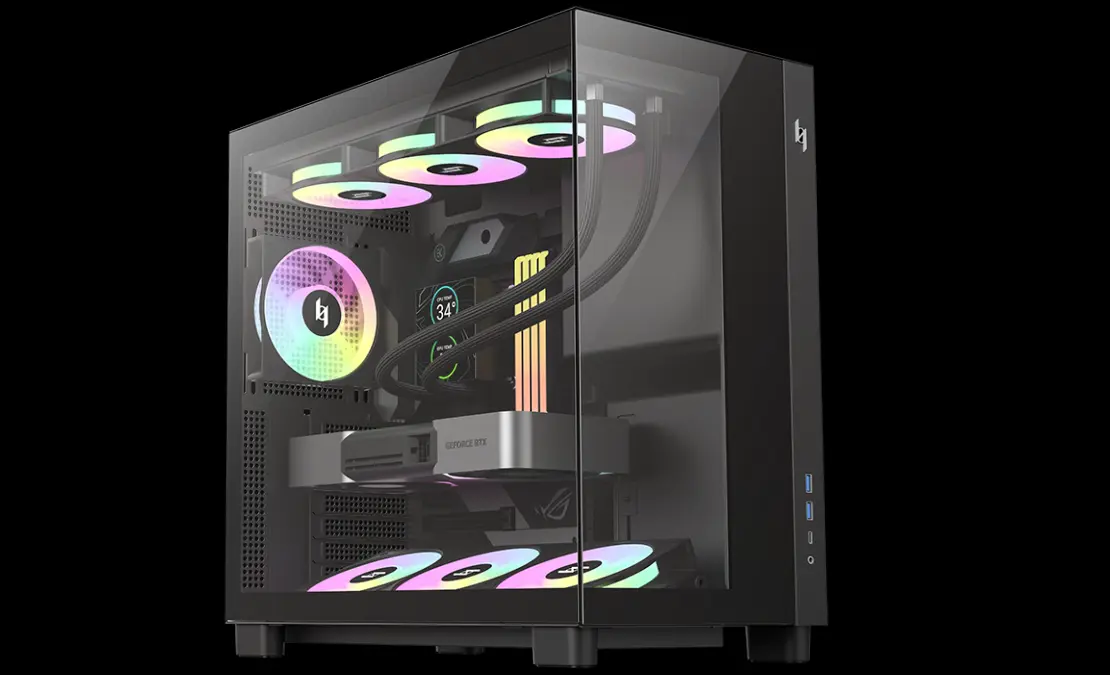

GAMEMAX (starting at $64.99 for black, $69.99 for white) positions its newly announced NEX C53 Panoramic Chassis as a compact showcase solution for modern PC builds. The Shenzhen-based manufacturer targets enthusiasts who want clean cable management through hidden-connector motherboard support while maintaining compatibility with high-performance hardware. Graphics cards up to 410mm fit inside, along with 360mm radiators and 175mm air coolers. The case supports next-generation platforms like ASUS BTF, MSI Project Zero, and GIGABYTE Stealth, which relocate power and data connectors to the motherboard’s rear. Four pre-installed ARGB fans and a dual-layer top panel deliver premium aesthetics without the typical $100-plus price tag. If you prioritize clean builds and don’t mind working within a compact chassis, the NEX C53 offers compelling value in the budget-to-midrange case market.
The Bottom Line
GAMEMAX’s NEX C53 Panoramic Chassis delivers hidden-connector motherboard support, extensive cooling options, and premium design elements at an accessible price point.
Pros:
- Hidden-connector motherboard compatibility
- Graphics cards up to 410mm supported
- Four pre-installed ARGB fans included
- 360mm radiator support
- Under $70 starting price
Cons:
- Limited to compact chassis constraints
- Untested thermal performance
- Front-mounted PSU may complicate builds
- Single-year warranty coverage
- New brand with limited track record
Key Specifications at a Glance
| Component | Specification |
|---|---|
| Max GPU Length | 410mm |
| Max CPU Cooler Height | 175mm |
| Radiator Support | 360mm (top-mounted) |
| PSU Compatibility | ATX up to 160mm (front-mounted) |
| Included Fans | 4x 120mm ARGB |
| Front I/O | 1x USB-C Gen 2×2, 2x USB 3.0 |
| Price (Black) | $64.99 |
| Price (White) | $69.99 |
Design Philosophy: Panoramic Views Meet Hidden Connectors
The NEX C53’s defining feature centers on its compatibility with hidden-connector motherboards from ASUS, MSI, and GIGABYTE. These platforms relocate 24-pin ATX power, 8-pin CPU power, and front-panel connectors to the motherboard’s rear, eliminating visible cable clutter. GAMEMAX redesigned the chassis layout to accommodate rear-side cable routing, which requires deeper clearance behind the motherboard tray.
You’ll notice the panoramic layout immediately. The design prioritizes component visibility through a minimalist internal structure. GAMEMAX removed traditional cable management bars and routing channels from the visible chamber, pushing connectivity to the hidden rear compartment. This approach works best with compatible motherboards but doesn’t prevent standard ATX board installation.
The dual-layer top panel replaces conventional mesh-and-filter designs. GAMEMAX stacks a solid outer layer over an inner ventilation layer, creating cleaner lines while maintaining airflow access. This design choice mirrors premium cases from manufacturers like Fractal Design and be quiet!, though the NEX C53’s $64.99 starting price undercuts those options by $30 to $50.
Cooling Configuration: Front PSU, Bottom Intake, Top Exhaust
GAMEMAX flipped the traditional PSU position from bottom-rear to front-bottom. This relocation serves two purposes. First, it opens space for graphics cards up to 410mm without PSU interference. Second, it allows full 360mm radiator support at the top of the chassis. The trade-off involves more complex PSU cable routing, particularly for builders using non-modular power supplies.
The chassis accommodates up to seven 120mm fans or five 140mm fans across bottom intake, top exhaust, and rear exhaust positions. GAMEMAX includes three 120mm reverse-blade ARGB fans at the bottom and one 120mm ARGB fan at the rear. The reverse-blade design references outward-facing impellers, which push air through a ring lighting element for consistent illumination.
The adjustable fan bracket addresses a common airflow challenge. You can angle bottom intake fans toward the GPU, toward the motherboard, or straight upward for radiator feeding. This flexibility matters most in compact cases where every millimeter of airflow direction impacts thermal performance. However, GAMEMAX hasn’t released independent thermal testing data, so actual cooling efficiency remains unverified.
Air cooler clearance tops out at 175mm, which excludes tower coolers like the Noctua NH-D15 (165mm) or be quiet! Dark Rock Pro 4 (162.8mm) with fans in push-pull configuration. You’ll fit most single-tower coolers comfortably, but dual-tower setups require careful measurement.
Hardware Compatibility: Modern GPUs and ATX Power Supplies Fit
The 410mm GPU length supports current flagship graphics cards without compromise. NVIDIA’s GeForce RTX 5090 Founders Edition measures 304mm, while partner cards from ASUS, MSI, and GIGABYTE typically range from 320mm to 380mm. Even extended models with triple-fan coolers and thick heatsinks clear the NEX C53’s internal depth.
ATX power supply support extends to 160mm, covering most standard units. Compact SFX power supplies offer more cable management space in the front chamber, though they typically cost $20 to $40 more than equivalent ATX models. The front-mounted PSU position places the intake fan against the chassis front panel, so you’ll want adequate ventilation clearance if desk placement restricts front airflow.
The built-in GPU support bracket addresses one of the most common hardware stress points. Modern graphics cards weigh between 1.5 and 3 pounds, creating significant leverage on the motherboard’s PCIe slot. GAMEMAX includes an adjustable bracket that contacts the GPU’s rear edge, distributing weight across the chassis floor rather than the motherboard alone. This feature typically appears in $100-plus cases, making its inclusion at the NEX C53’s price point noteworthy.
Connectivity and Build Features: USB-C Gen 2×2 Leads Front I/O
Front panel connectivity includes one USB Type-C Gen 2×2 port and two USB 3.0 ports. The USB-C Gen 2×2 specification delivers 20Gbps transfer speeds, matching the latest motherboard front-panel headers. This represents current-generation I/O rather than cutting-edge USB4 implementation, but it exceeds the USB-C Gen 2 (10Gbps) found on competing budget cases.
The two USB 3.0 Type-A ports provide 5Gbps speeds for peripherals like external drives, controllers, or RGB hubs. GAMEMAX positions the I/O panel on the top front edge, keeping ports accessible while maintaining the clean panoramic view.
Color options include black and white variants, with the white version commanding a $5 premium ($69.99 versus $64.99). This pricing structure mirrors industry standards, where non-black finishes typically add $5 to $15 to manufacturing costs due to powder coating complexity.
Competitive Context: Budget Cases With Premium Features
The NEX C53 enters a crowded budget-to-midrange case market dominated by established brands. Competing options include:
Lian Li Lancool 216 ($114.99): Offers superior airflow testing results, includes two 160mm fans, and provides more internal space. However, it lacks hidden-connector motherboard support and costs $50 more than the NEX C53.
Fractal Design North ($134.99): Delivers premium wood-accented aesthetics, excellent thermal performance, and refined build quality. The $70 price difference reflects established brand reputation and proven design execution.
Corsair 4000D Airflow ($104.99): Provides flexible cooling configurations, tool-free tempered glass access, and wide compatibility. Corsair’s track record and customer support justify the $40 premium over GAMEMAX’s newcomer offering.
Montech Air 903 Max ($69.99): Matches the NEX C53’s price point while including four ARGB fans and 360mm radiator support. Lacks hidden-connector motherboard compatibility but offers proven thermal performance data.
GAMEMAX differentiates through hidden-connector support at a budget price. If you plan to build with ASUS BTF, MSI Project Zero, or GIGABYTE Stealth motherboards, competing cases require $120-plus investments to achieve similar cable-free aesthetics. The NEX C53 undercuts that threshold by nearly 50%.
Warranty and Availability: One-Year Coverage Raises Questions
GAMEMAX backs the NEX C53 with a one-year manufacturer’s warranty. This coverage period falls below industry standards, where established case manufacturers typically provide two to five years of warranty protection. Corsair, Fractal Design, and Lian Li all offer multi-year warranties that cover manufacturing defects, structural failures, and component issues.
The limited warranty suggests either cost optimization or limited confidence in long-term durability. PC cases rarely fail through normal use, but tempered glass panels, fan headers, and I/O ports represent potential failure points. One year of coverage protects initial build quality but leaves longer-term ownership risks with the buyer.
The NEX C53 launches in January 2026 with immediate availability. GAMEMAX hasn’t specified regional distribution beyond US pricing, so international availability and pricing remain unclear. The company’s limited market presence outside Asia means potential buyers should verify retailer support and return policies before purchase.
Who Should Consider the GAMEMAX NEX C53
The NEX C53 makes sense for specific builder profiles. If you’re planning a build around hidden-connector motherboards like ASUS BTF or MSI Project Zero, the case delivers necessary rear-side cable routing at a fraction of competing prices. The $64.99 black version represents compelling value for showcase builds where cable visibility matters.

Budget-conscious builders who want included ARGB fans will appreciate the four pre-installed units. Buying a $50 case and adding four ARGB fans separately typically adds $30 to $50 to total cost, placing you in $80-$100 territory. The NEX C53 bundles both elements below $70.
However, you should consider alternatives if you prioritize proven thermal performance, extended warranty coverage, or established brand support. The NEX C53’s compact dimensions and front-mounted PSU create potential airflow challenges that independent testing hasn’t yet validated. Builders working with high-wattage GPUs (400W-plus) or overclocked CPUs may find better thermal results in cases with documented airflow data.
For first-time builders, the front-mounted PSU and compact layout add complexity compared to traditional mid-tower designs. The Corsair 4000D Airflow or Fractal Design Meshify C offer more straightforward build processes with extensive online documentation and community support.
Frequently Asked Questions
Will the GAMEMAX NEX C53 support my graphics card?
The NEX C53 accommodates graphics cards up to 410mm in length, which covers all current NVIDIA GeForce RTX 5000-series and AMD Radeon RX 8000-series models, including extended partner designs. Check your specific card’s length against this clearance.
Do I need a hidden-connector motherboard to use the NEX C53?
No. The NEX C53 supports standard ATX, Micro-ATX, and Mini-ITX motherboards with traditional front-side connectors. Hidden-connector support adds cable management benefits but isn’t required for basic compatibility.
How does the front-mounted PSU affect airflow?
The front PSU position frees space for longer GPUs and top-mounted radiators. However, it places the PSU intake against the front panel, potentially restricting airflow if desk placement blocks ventilation. GAMEMAX hasn’t released thermal testing data comparing this layout to traditional bottom-mounted PSU designs.
What’s the difference between the $64.99 and $69.99 versions?
The $5 price difference reflects color options. The black version costs $64.99, while the white version costs $69.99. Both variants include identical features, specifications, and four pre-installed ARGB fans.
Should I buy the NEX C53 or wait for reviews?
If you’re building with a hidden-connector motherboard and want budget pricing, the NEX C53’s feature set justifies consideration. However, waiting for independent thermal testing and build quality assessments provides clearer performance context, particularly regarding the front-mounted PSU’s cooling impact.
Does the one-year warranty match competing cases?
No. Most established case manufacturers offer two to five years of warranty coverage. GAMEMAX’s one-year warranty suggests cost optimization but leaves longer-term reliability unproven. Consider extended retailer warranties if available.