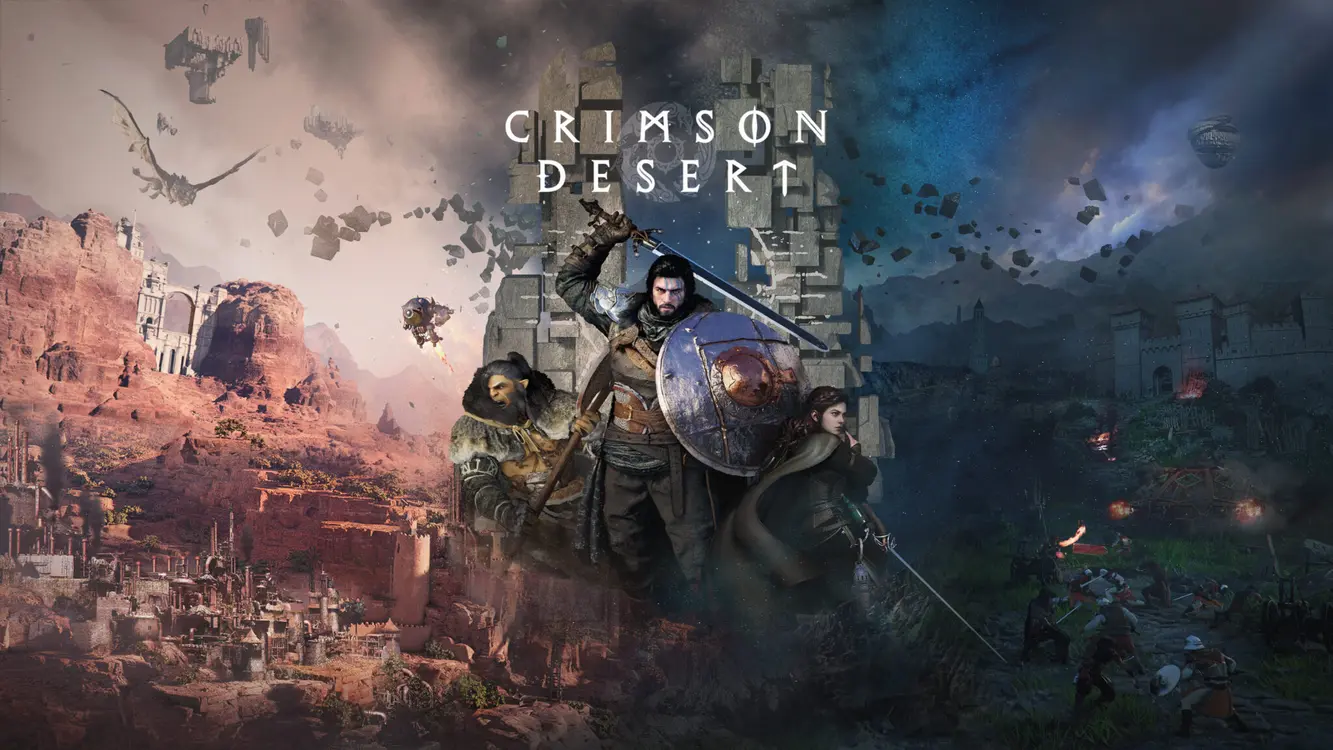

Pearl Abyss set out to build the ultimate open-world action game. Instead, it built a fascinating compromise: a massive, frequently striking adventure that borrows liberally from The Witcher 3, Red Dead Redemption 2, Tears of the Kingdom, and Skyrim, then struggles to match the best of any of them. Crimson Desert isn’t a failure, but it is a case study in what happens when ambition outruns polish. Across roughly 130 hours covering the main story and a substantial slice of side content, it delivered genuine highs and genuine frustrations in nearly equal measure.
A World Worth Getting Lost In
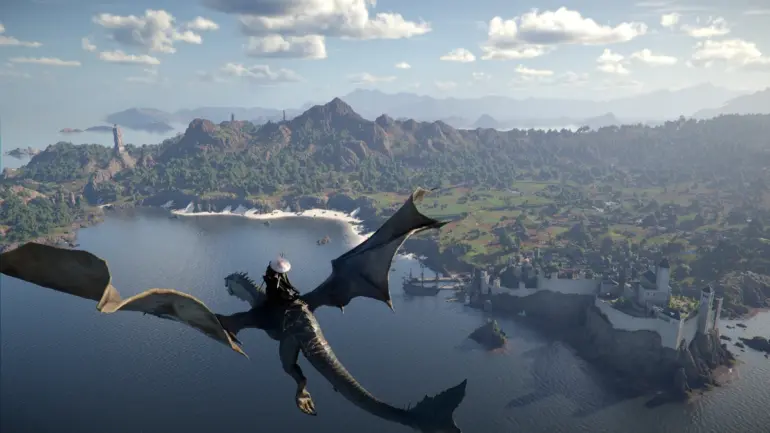
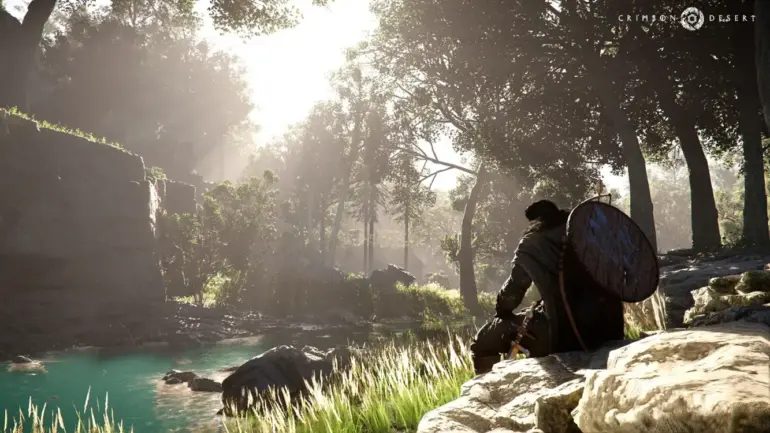
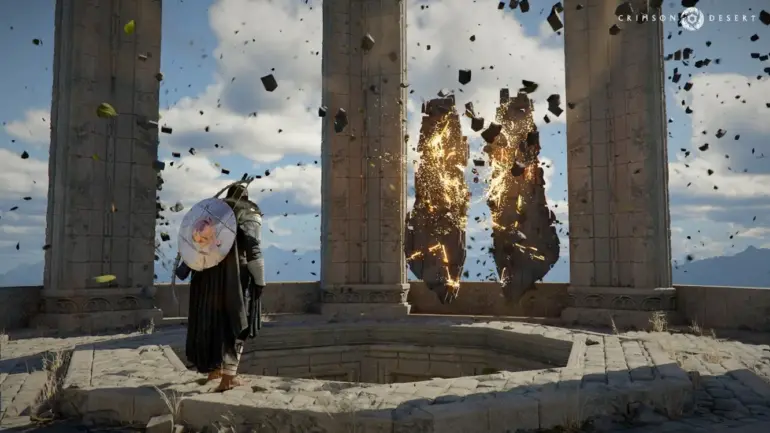
Visually, Crimson Desert earns its place among the most arresting open worlds in recent years. View distances are extraordinary, and the environmental layering, from fog-draped marshlands to torchlit bandit camps perched on cliffsides, creates a world that pulls you toward the horizon constantly. Lighting in particular does heavy lifting: golden-hour passes across stone ruins look cinematic in a way that recalls the best of Hidetaka Miyazaki’s environmental storytelling, even if Crimson Desert’s world lacks that franchise’s narrative economy.
The technical achievement is real. Pearl Abyss has delivered one of the better-optimized PC releases in recent memory. Even lower-end hardware configurations hold a respectable frame rate, and the game scales well across a range of setups. Environments and large enemy clusters read clearly on screen. The weak link is character faces in cutscenes, where lip sync lags noticeably and the fidelity dips enough to pull you out of story moments that were already doing little to hold you in.
Kliff, and the Story That Surrounds Him
The three playable characters rotate through the main narrative, but Kliff, a viking-coded mercenary on a low-stakes revenge mission against a rival barbarian faction, leads the opening. His arc establishes the template the story will follow throughout: vague personal stakes, forgettable antagonists, and dialogue that rarely rises above perfunctory. The revenge premise is straightforward enough, but neither the writing nor the character work give it weight.
The supporting cast fares no better. Companions are underwritten, antagonists fail to function as meaningful thematic mirrors to the protagonists, and one multi-chapter story arc hinges entirely on a character who dies before the game begins. That character becomes the emotional anchor for multiple funeral sequences spread hours apart, and the script never earns the grief it keeps asking you to feel. It’s a structural miscalculation. Pearl Abyss clearly wanted players to invest in its fiction, given how much screen time goes to companion conversations and cutscenes. The investment just isn’t warranted. The anime-style action sequences land better, delivering kinetic, stylized choreography that works on pure spectacle.
Combat: Breadth Without Refinement
The Core Loop
Crimson Desert’s combat is built around a flexible action foundation: light and heavy attacks, dodges, a parry system, and a growing toolkit of special abilities unlocked through a branched skill tree. Input response is reasonably tight, and moment-to-moment skirmishes against small groups have a decent rhythmic quality. The problem is scale.
Almost every encounter begins with twelve or more enemies, then layers in reinforcements as the first wave falls. What should take ninety seconds stretches to four or five minutes. Crossing a bridge, entering a settlement, moving between objectives: all of it runs through these extended skirmishes. The pacing toll accumulates quickly, and the later war scenarios push the design to its breaking point. In one sequence, you’re asked to plant a flag in open ground while surrounded by dozens of enemies, unable to defend yourself as you drag the banner slowly across the field. It’s less a tactical challenge and more an endurance test with no interesting decision inside it.
Boss Encounters
The boss fights represent Crimson Desert’s most jarring tonal inconsistency. The casual action framing of standard combat abruptly gives way to soulslike multi-phase encounters with small punishment windows, heavy damage outputs, and mechanics that demand a different toolkit than anything the surrounding game cultivates. One early example has you carving through bandits with little resistance, then dropping into a three-phase boss that includes a segment where you must destroy totems while being relentlessly swarmed. Survival is less about reading the encounter and more about having enough consumables to outlast it.
As someone with a genuine affinity for demanding parry-based combat, these fights still felt poorly balanced rather than challenging. They aren’t difficult in a rewarding sense; they’re sluggish in a frustrating one. Pearl Abyss has already issued nerfs to at least one encounter, and likely more will follow, but the fundamental design tension between the game’s casual-action default and these outlier encounters won’t be fully resolved by tuning numbers alone.

Skills, Controls, and the Readability Problem
The skill tree branches sensibly in concept. One path develops mobility, including a grapple that traverses long distances and scales vertical surfaces quickly, and a gliding ability that meaningfully changes traversal. Another unlocks combat extensions like shield bashing and a dropkick that sends enemies airborne. The mobility unlocks integrate well and feel worth earning. The combat extensions are more uneven: archery skills add little regardless of investment, and several combat abilities are close enough in function that distinguishing them in practice is more trouble than the differentiation warrants.
The control scheme compounds this. By default, button assignments use multi-step combinations for frequently used actions. Crouching, summoning gadgets, and sprinting all live on overlapping or unintuitive inputs, and the sprint in particular asks for repeated button taps rather than a hold, a choice that reads as eccentric. A dragon mount acquired late in the game requires a time-sensitive button press to board correctly, one that fails more often than it succeeds and sends the player dropping instead. These friction points erode the fluency the game otherwise builds toward.


Puzzles and Secondary Systems
Puzzle design sits at the shallow end of the spectrum. Most solutions hinge on finding the intended path rather than lateral thinking, and the gap between the intended approach and an unintentional workaround is often invisible. In one instance, reaching a puzzle’s upper level requires climbing with a stamina cap that blocks the direct route. The solution the game accepts looks indistinguishable from exploiting an oversight. Completing the puzzle produces more relief than satisfaction.
Stealth sections are a persistent weak point. They don’t integrate with the traversal or combat tools in ways that make them interesting, and they function as pacing obstacles rather than meaningful gameplay diversions.
Where Crimson Desert earns goodwill is in its breadth of optional engagements. Arm wrestling, fishing, gambling, a light settlement-management mode where you deploy allies to gather resources, grilling hunted animals before a large battle: these systems are shallow individually but collectively give the world texture and personality. Some of the best moments came from ignoring the critical path entirely and wandering into unscripted corners of the map well before the game suggested doing so.
Progression and the Inventory Problem
Skill progression is gated behind a currency earned through combat and exploration, with unlocks split across each character’s tree. The gating feels appropriate for mobility skills, which open genuine new movement options. The combat tree is more cluttered, offering more options than most players will use or meaningfully differentiate.
The inventory system is a more significant structural issue. Carrying capacity fills quickly, and at launch there was no storage option: items that couldn’t fit on your person had to be discarded. For a game centered on collecting loot, unique weapons, and materials, that’s a real friction point. Capacity was partially expanded during the review period following player feedback, but the constraint still makes itself felt. Pearl Abyss has said storage will be added post-launch. Its absence at release reflects a broader launch-readiness problem that runs through the game.
Technical State
Bugs range from minor to progress-blocking. Companions get stuck in geometry. Objectives fail to register. One critical quest step during the late main story didn’t trigger correctly, requiring a rollback to a save file from seven hours earlier. Proceeding ultimately required copying a colleague’s save. Pearl Abyss has patched that specific issue and has added fast travel points relative to the review build, so some rough edges have been addressed. For an open world this large, full stability will be a longer process.
Verdict
Crimson Desert attempts more than most open-world games in recent memory, and that breadth is both its defining quality and its most consistent liability. The world is visually impressive and genuinely rewarding to explore at your own pace, with enough optional diversions to sustain curiosity across many hours. But the combat outstays its welcome by design, the boss encounters feel imported from a different game, the story rarely rises to the occasions it manufactures, and the launch build carried technical problems significant enough to derail playthroughs entirely. There’s an earnest and frequently interesting game in here. Getting to it reliably requires tolerating a lot of rough terrain.